🎯 Objectifs de la leçon
À la fin de cette leçon, vous serez capable de :
- Distinguer l’engagement comportemental de l’engagement cognitif.
- Identifier les fausses formes de participation (piège du silence).
- Repérer les indicateurs concrets d’un engagement réel.
- Analyser votre propre pratique via le test des 3 questions.
Idée clé
Le calme ne garantit pas l’apprentissage.
L’engagement réel se voit dans l’activité mentale.
Confusion fréquente : Le silence et la main levée sont des postures, pas nécessairement des preuves de réflexion.
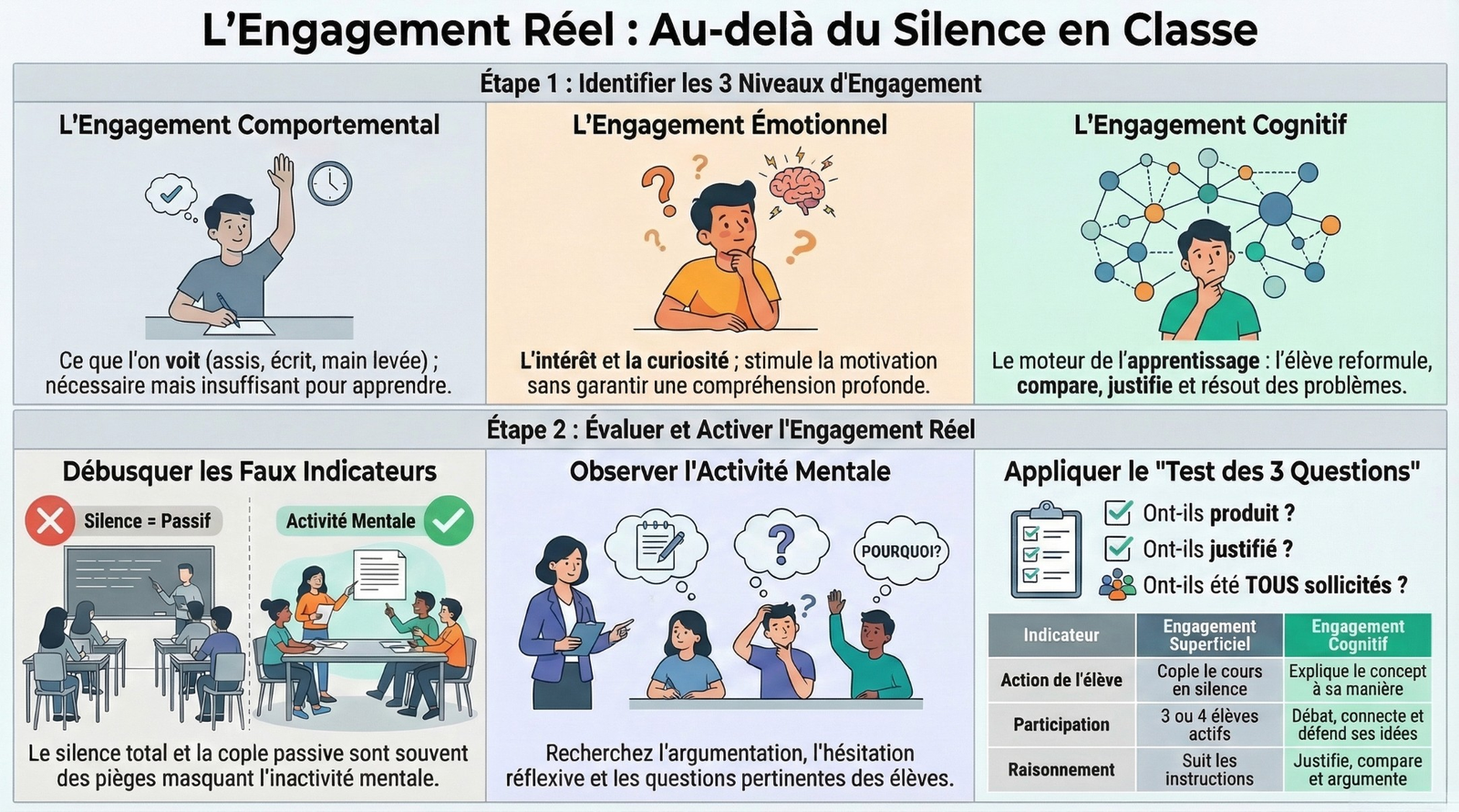
Les 3 niveaux d’engagement
Distinguer ce qui relève de la posture visible, de l’état émotionnel et du travail cognitif réel.
1) Engagement comportemental
- Posture : assis, regarde le tableau, écrit.
- Risque : peut copier sans comprendre.
→
2) Engagement émotionnel
- Posture : curiosité, plaisir, motivation.
- Risque : peut aimer le cours sans apprendre.
→
3) Engagement cognitif (Le Graal)
C’est ici que l’apprentissage se produit. L’élève :
- Reformule avec ses propres mots.
- Justifie ses réponses et résout des problèmes.
- Pose des questions de compréhension profonde.
1) Engagement comportemental
- Posture : assis, regarde le tableau, écrit.
- Risque : peut copier sans comprendre.
2) Engagement émotionnel
- Posture : curiosité, plaisir, motivation.
- Risque : peut aimer le cours sans apprendre.
3) Engagement cognitif (Le Graal)
C’est ici que l’apprentissage se produit. L’élève :
- Reformule avec ses propres mots.
- Justifie ses réponses et résout des problèmes.
- Pose des questions de compréhension profonde.
🛠 Outil : Le test des 3 questions
Un filtre simple pour vérifier si une activité produit de l’engagement réel ou seulement une participation de surface.
Pour chaque activité, demandez-vous :
1
Production
Les élèves ont-ils produit quelque chose (écrit, oral, schéma) ?
2
Justification
Ont-ils dû justifier ou comparer ?
3
Participation totale
Tous les élèves ont-ils été sollicités ?
- Les élèves ont-ils produit quelque chose (écrit, oral, schéma) ?
- Ont-ils dû justifier ou comparer ?
- Tous les élèves ont-ils été sollicités ?
Si la réponse est “Non” à deux questions ou plus, l’activité est probablement passive.
🎯 Lesson Objectives
By the end of this lesson, you will be able to:
- Distinguish behavioral engagement from cognitive engagement.
- Identify false forms of participation (the silence trap).
- Recognize concrete indicators of real engagement.
- Analyze your own practice using the 3-question test.
Key Idea
Calm does not guarantee learning.
Real engagement is visible through mental activity.
Common Confusion: Silence and raised hands are postures, not necessarily proof of thinking.
The 3 Levels of Engagement
Separate visible posture, emotional state, and genuine cognitive work.
1) Behavioral Engagement
- Posture: sitting, looking at the board, writing.
- Risk: can copy without understanding.
→
2) Emotional Engagement
- Posture: curiosity, enjoyment, motivation.
- Risk: can like the class without deep learning.
→
3) Cognitive Engagement (The Goal)
This is where learning actually happens. The student:
- Rephrases in their own words.
- Justifies answers and solves problems.
- Asks deep comprehension questions.
1) Behavioral Engagement
- Posture: sitting, looking at the board, writing.
- Risk: can copy without understanding.
2) Emotional Engagement
- Posture: curiosity, enjoyment, motivation.
- Risk: can like the class without deep learning.
3) Cognitive Engagement (The Goal)
This is where learning actually happens. The student:
- Rephrases in their own words.
- Justifies answers and solves problems.
- Asks deep comprehension questions.
🛠 Tool: The 3-Question Test
A simple filter to check whether an activity generates real engagement or only surface participation.
For every activity, ask yourself:
1
Production
Did students produce something (writing, speaking, diagram)?
2
Justification
Did they have to justify or compare?
3
Total participation
Were all students involved?
- Did students produce something (writing, speaking, diagram)?
- Did they have to justify or compare?
- Were all students involved?
If the answer is “No” to two or more questions, the activity is likely passive.
🎯 أهداف الدرس
في نهاية هذا الدرس ستكون قادراً على:
- التمييز بين الانخراط السلوكي والانخراط الذهني.
- كشف المشاركة الشكلية (فخ الصمت).
- التعرف على مؤشرات الانخراط الحقيقي.
- تحليل ممارستك الصفية عبر اختبار الأسئلة الثلاثة.
الفكرة الأساسية
الهدوء لا يضمن التعلم.
الانخراط الحقيقي يظهر في النشاط الذهني.
خلط شائع: الصمت ورفع اليد مجرد مظاهر، وليست بالضرورة دليلاً على التفكير.
ثلاثة مستويات للانخراط
التمييز بين المظهر الخارجي، والحالة الوجدانية، والعمل الذهني الحقيقي.
1) الانخراط السلوكي
- المظهر: جلوس، نظر للسبورة، كتابة.
- الخطر: يمكن للتلميذ أن ينقل دون فهم.
←
2) الانخراط العاطفي
- المظهر: فضول، استمتاع، دافعية.
- الخطر: قد يحب التلميذ الحصة دون تعلم عميق.
←
3) الانخراط الذهني (الهدف الأسمى)
هنا يحدث التعلم الحقيقي. التلميذ:
- يعيد الصياغة بكلماته الخاصة.
- يبرر إجاباته ويحل المشكلات.
- يطرح أسئلة فهم عميقة.
1) الانخراط السلوكي
- المظهر: جلوس، نظر للسبورة، كتابة.
- الخطر: يمكن للتلميذ أن ينقل دون فهم.
2) الانخراط العاطفي
- المظهر: فضول، استمتاع، دافعية.
- الخطر: قد يحب التلميذ الحصة دون تعلم عميق.
3) الانخراط الذهني (الهدف الأسمى)
هنا يحدث التعلم الحقيقي. التلميذ:
- يعيد الصياغة بكلماته الخاصة.
- يبرر إجاباته ويحل المشكلات.
- يطرح أسئلة فهم عميقة.
🛠 أداة: اختبار الأسئلة الثلاثة
مرشح بسيط يساعد على التحقق مما إذا كان النشاط يولد انخراطاً حقيقياً أو مجرد مشاركة سطحية.
لكل نشاط، اسأل نفسك:
1
الإنتاج
هل أنتج التلاميذ شيئاً (كتابة، عرض شفهي، رسم)؟
2
التبرير
هل اضطروا للتبرير أو المقارنة؟
3
إشراك الجميع
هل تم إشراك جميع التلاميذ؟
- هل أنتج التلاميذ شيئاً (كتابة، عرض شفهي، رسم)؟
- هل اضطروا للتبرير أو المقارنة؟
- هل تم إشراك جميع التلاميذ؟
إذا كانت الإجابة “لا” على سؤالين أو أكثر، فالنشاط غالباً سلبي.
×
Fichier introuvable : leçon 3.1 Qu’est-ce que l’engagement réellement ?.html