Travail et puissance d’une force.
Introduction :
I. Travail d’une force constante
1- Effets possibles d’une force
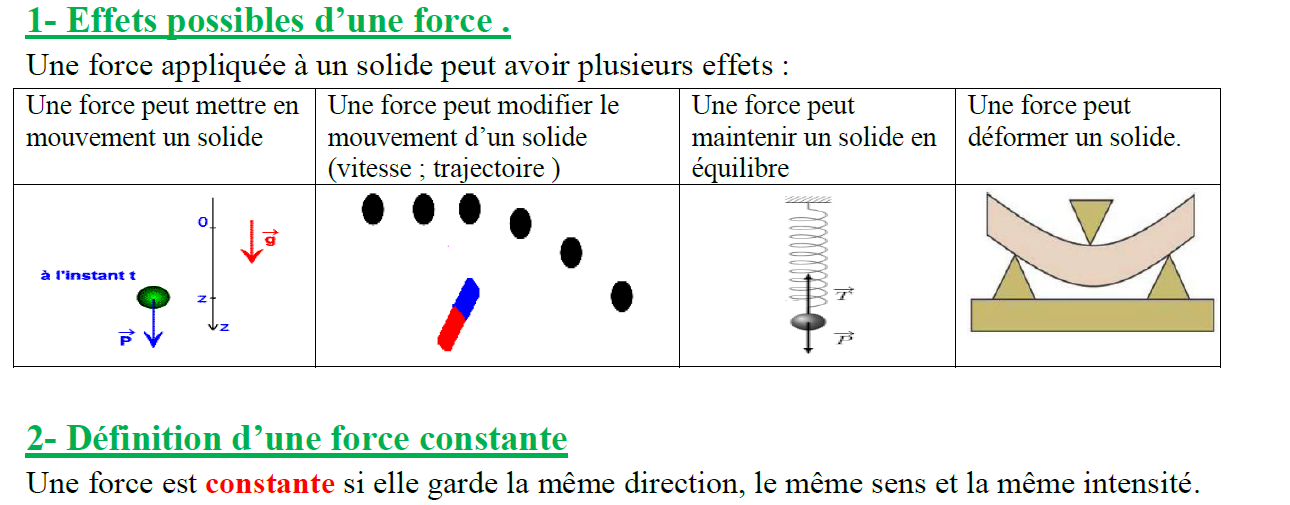
Une force appliquée à un solide peut avoir plusieurs effets :
2- Définition d’une force constante
Une force est constante si elle garde la même direction, le même sens et la même intensité.
| Une force peut mettre en mouvement un solide | Une force peut modifier le mouvement d’un solide (vitesse ; trajectoire ) | Une force peut maintenir un solide en équilibre | Une force peut déformer un solide. |
 |
 |
 |
 |
II. Travail d’une force constante dans le cas d’un solide en translation ou en rotation
1. Travail d’une force constante pour un déplacement rectiligne
Le travail d’une force constante $overrightarrow{mathrm{F}}$ pour un déplacement rectiligne $overrightarrow{mathrm{AB}}$ de son point d’application noté $underset{A rightarrow B}{W}(vec{F})$ est le produit scalaire du vecteur force $vec{F}$ et du vecteur déplacement $overrightarrow{A B}$.
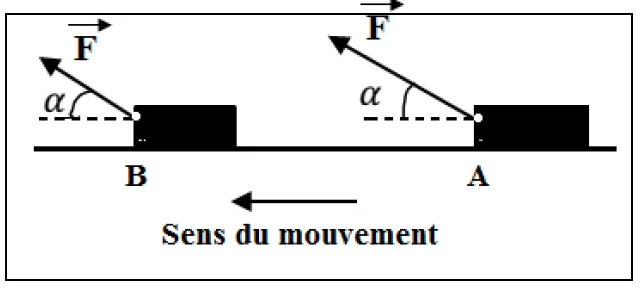
$begin{aligned} & {underset{A}{A rightarrow B}}^{( }(vec{F})=vec{F} cdot overrightarrow{A B} \ & W_{A rightarrow B}(vec{F})=F cdot A B cdot cos alphaend{aligned}$
Avec $alpha$ l’angle entre les vecteurs $vec{F}$ et $overrightarrow{A B}$
L’unité de travail est le Joule (symbole J).
2. Travail moteur, travail résistant
Le travail d’une force est une grandeur algébrique.
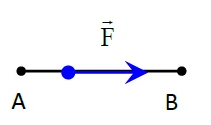
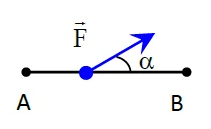
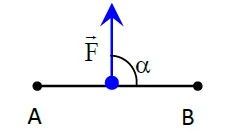
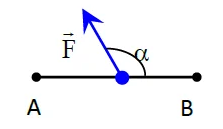
Un travail positif est un travail moteur et un travail négatif est un travail résistant.
| α = 0° | α < 90° | α = 90° | 90° < α ≤ 180° | α = 180° |
|---|---|---|---|---|
 |
 |
 |
 |
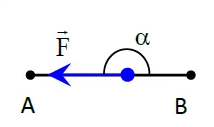 |
| $mathrm{W}_{mathrm{AB}}(overrightarrow{mathrm{F}})$ positif : Travail moteur | $mathrm{W}_{mathrm{AB}}(overrightarrow{mathrm{F}})$ positif : Travail moteur | $mathrm{W}_{mathrm{AB}}(overrightarrow{mathrm{F}})$ = 0 | $mathrm{W}_{mathrm{AB}}(overrightarrow{mathrm{F}})$ négatif : Travail résistant | $mathrm{W}_{mathrm{AB}}(overrightarrow{mathrm{F}})$ négatif : Travail résistant |
3. Travail d’une force constante pour un déplacement quelconque

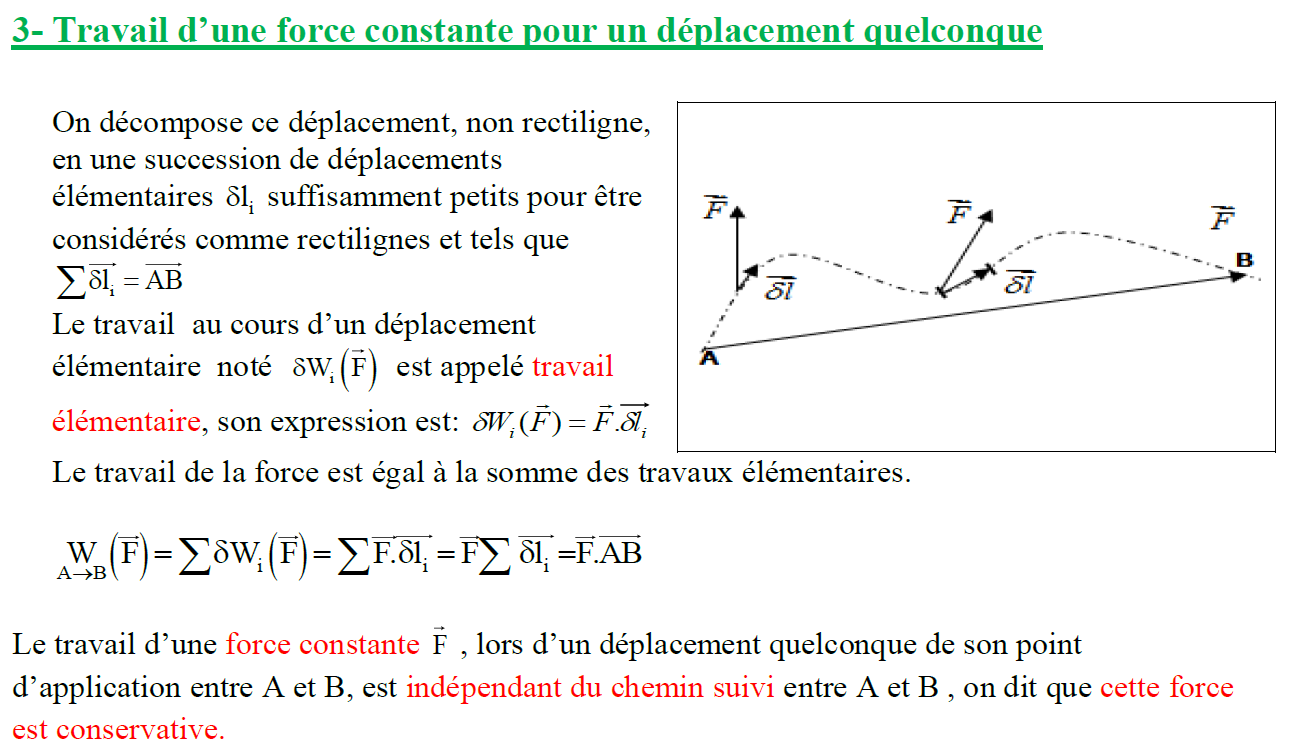
On décompose ce déplacement, non rectiligne,
en une succession de déplacements élémentaires $delta 1_i$ suffisamment petits pour être considérés comme rectilignes et tels que $sum overrightarrow{delta mathrm{l}_1}=overrightarrow{mathrm{AB}}$
Le travail au cours d’un déplacement élémentaire noté $delta mathrm{W}_{mathrm{i}}(overrightarrow{mathrm{F}})$ est appelé travail élémentaire, son expression est: $delta W_i(vec{F})=vec{F} cdot overrightarrow{delta_i}$ Le travail de la force est égal à la somme des travaux élémentaires.
$$
underset{A rightarrow B}{ }(vec{F})=sum delta W_i(vec{F})=sum vec{F} cdot delta_i=vec{F} sum overrightarrow{delta I_i}=vec{F} cdot overrightarrow{A B}
$$
Le travail d’une force constante $overrightarrow{mathrm{F}}$, lors d’un déplacement quelconque de son point d’application entre A et B, est indépendant du chemin suivi entre A et B , on dit que cette force est conservative.
Application: Travail du poids
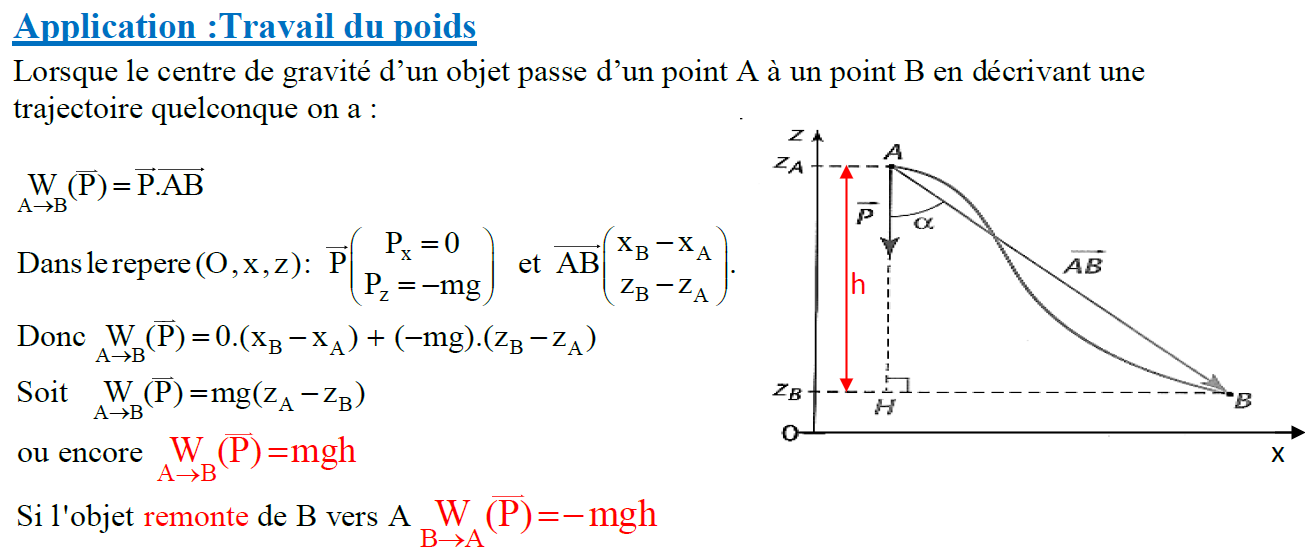
Lorsque le centre de gravité d’un objet passe d’un point A à un point B en décrivant une trajectoire quelconque on a :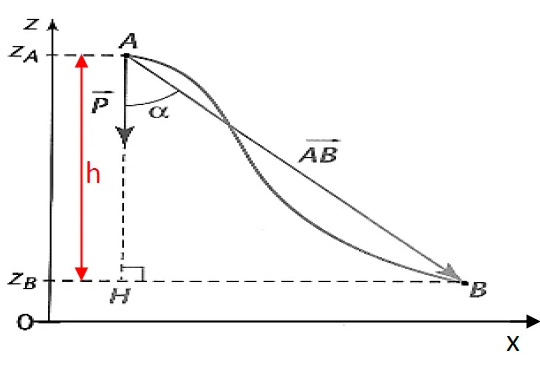
$$
underset{mathrm{A} rightarrow mathrm{~B}}{ }(stackrel{rightharpoonup}{mathrm{P}})=overrightarrow{mathrm{P}} cdot stackrel{mathrm{AB}}{ }
$$
Danslerepere $(O, x, z): vec{P}binom{P_x=0}{P_z=-m g}$ et $overrightarrow{A B}binom{x_B-x_A}{z_B-z_A}$.
Donc $underset{mathrm{A} rightarrow mathrm{B}}{mathrm{W}}(overline{mathrm{P}})=0 cdotleft(mathrm{x}_{mathrm{B}}-mathrm{x}_{mathrm{A}}right)+(-mathrm{mg}) cdotleft(mathrm{z}_{mathrm{B}}-mathrm{z}_{mathrm{A}}right)$
Soit $quad underset{mathrm{A} rightarrow mathrm{B}}{mathrm{W}}(mathrm{P})=mathrm{mg}left(mathrm{z}_{mathrm{A}}-mathrm{z}_{mathrm{B}}right)$
ou encore $underset{mathrm{A} rightarrow mathrm{B}}{mathrm{W}}(mathrm{P})=mathrm{mgh}$
Si l’objet remonte de B vers A $underset{mathrm{B} rightarrow mathrm{A}}{mathrm{W}}(overline{mathrm{P}})=-mathrm{mgh}$
4. Travail d’un ensemble de forces constantes
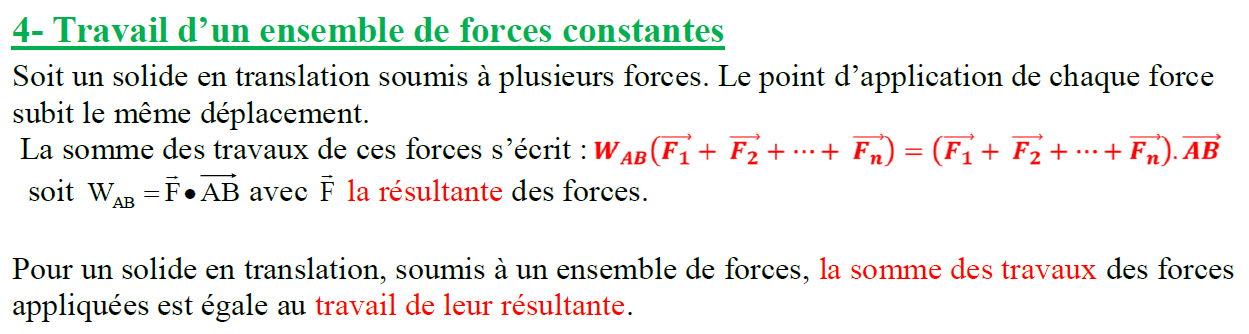
Soit un solide en translation soumis à plusieurs forces. Le point d’application de chaque force subit le même déplacement.
La somme des travaux de ces forces s’écrit : $W_{A B}left(overrightarrow{F_1}+overrightarrow{F_2}+cdots+overrightarrow{F_n}right)=left(overrightarrow{F_1}+overrightarrow{F_2}+cdots+overrightarrow{F_n}right) cdot overrightarrow{A B}$
soit $mathrm{W}_{mathrm{AB}}=overrightarrow{mathrm{F}} bullet overrightarrow{mathrm{AB}}$ avec $overrightarrow{mathrm{F}}$ la résultante des forces.
Pour un solide en translation, soumis à un ensemble de forces, la somme des travaux des forces appliquées est égale travail de leur résultante.
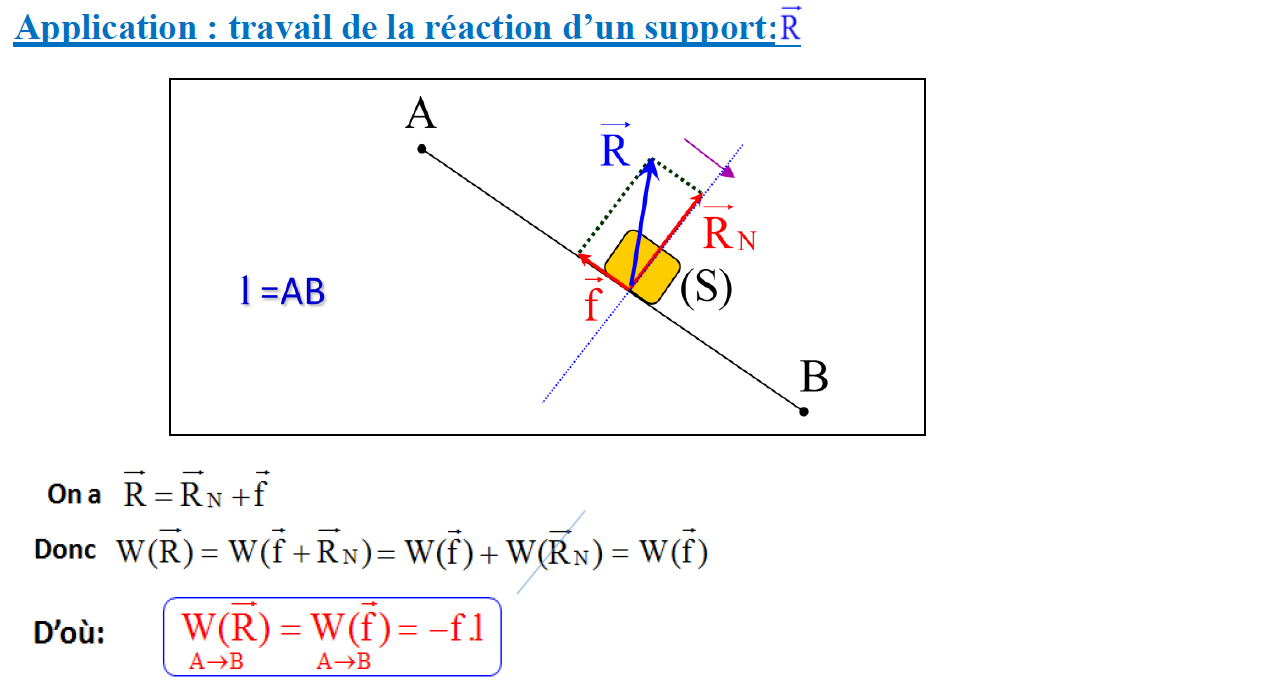
Application : travail de la réaction d’un support: $overrightarrow{mathrm{R}}$R}}$
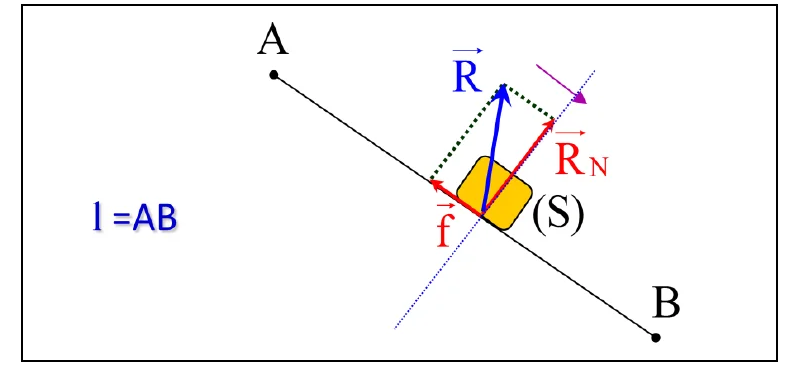 Ona $quad vec{R}=vec{R}_N+vec{f}$
Donc $mathrm{W}(overrightarrow{mathrm{R}})=mathrm{W}left(overrightarrow{mathrm{f}}^{+} overrightarrow{mathrm{R}}_{mathrm{N}}right)=mathrm{W}left(overrightarrow{mathrm{f}}_{mathrm{f}}right)+mathrm{W}left(overrightarrow{mathrm{R}}_{mathrm{N}}right)=mathrm{W}left(overrightarrow{mathrm{f}}_{mathrm{f}}right)$
D’où: $quad underset{A rightarrow B}{W(vec{R})}=underset{A rightarrow B}{W}(vec{f})=-f .1$
5. travail d’une force de moment constant dans le cas d’un solide en rotation autour d’un axe fixe
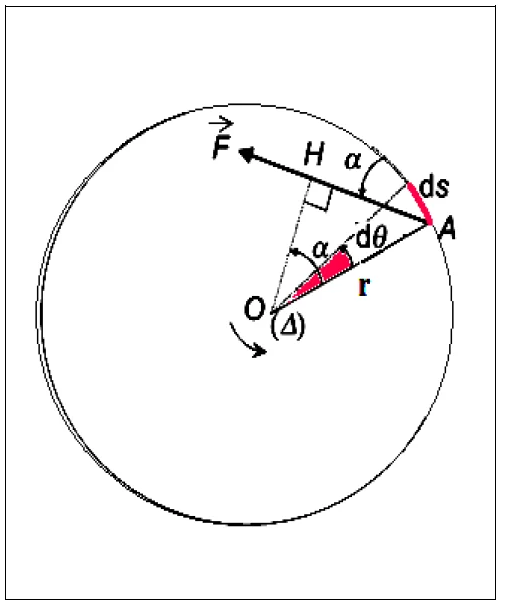
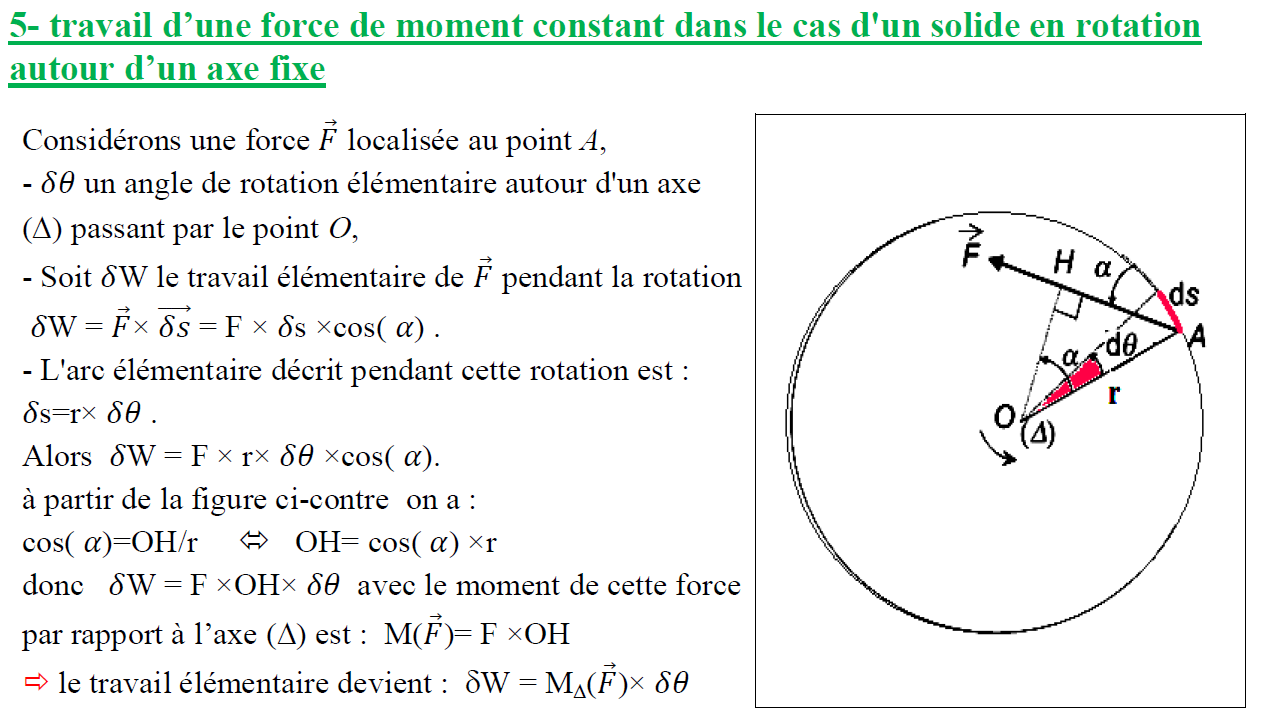
Considérons une force $vec{F}$ localisée au point $A$,
– $delta theta$ un angle de rotation élémentaire autour d’un axe
$(Delta)$ passant par le point $O$,
– Soit $delta mathrm{W}$ le travail élémentaire de $vec{F}$ pendant la rotation $delta mathrm{W}=vec{F} times overrightarrow{delta s}=mathrm{F} times delta mathrm{s} times cos (alpha)$.
– L’arc élémentaire décrit pendant cette rotation est : $delta mathrm{s}=mathrm{r} times delta theta$.
Alors $delta mathrm{W}=mathrm{F} times mathrm{r} times delta theta times cos (alpha)$.
à partir de la figure ci-contre on a :
$$
cos (alpha)=mathrm{OH} / mathrm{r} Leftrightarrow mathrm{OH}=cos (alpha) times mathrm{r}
$$
donc $delta mathrm{W}=mathrm{F} times mathrm{OH} times delta theta$ avec le moment de cette force par rapport à l’axe ( $Delta$ ) est : $mathrm{M}(vec{F})=mathrm{F} times mathrm{OH}$
$Rightarrow$ le travail élémentaire devient : $delta mathrm{W}=mathrm{M}_{Delta}(vec{F}) times delta theta$
– Lorsque le solide tourne d’un angle $Delta Theta$ le travail de force $vec{F}$ est : $mathrm{W}(vec{F})=sum delta W=sum M_{Delta}(vec{F}) times delta theta=M_{Delta}(vec{F}) times sum delta theta$ car $M_{Delta}(vec{F})$ est constant.
Et puisque $sum delta theta=Delta theta$ alors : $mathrm{W}(vec{F})=M_{Delta}(vec{F}) times Delta theta$
Le travail d’une force de moment constant dans le cas d’un solide en rotation autour d’un axe fixe est $mathrm{W}(vec{F})=M_{Delta}(vec{F}) times Delta theta$
III. Puissance d’une force :
1. La puissance movenne
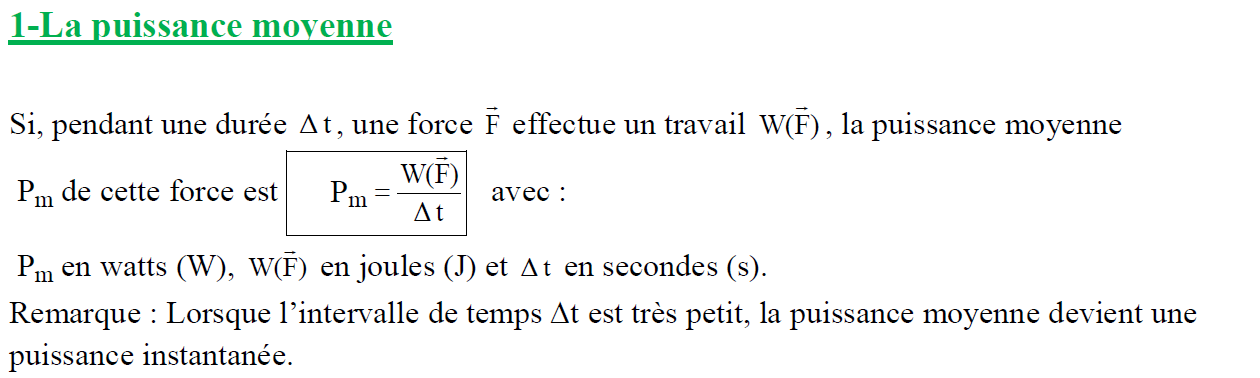
Si, pendant une durée $Delta t$, une force $overrightarrow{mathrm{F}}$ effectue un travail $mathrm{W}(overrightarrow{mathrm{F}})$, la puissance moyenne
$mathrm{P}_{mathrm{m}}$ de cette force est $quad mathrm{P}_{mathrm{m}}=frac{mathrm{W}(overrightarrow{mathrm{F}})}{Delta mathrm{t}}$ avec :
$mathrm{P}_{mathrm{m}}$ en watts (W), W( $overrightarrow{mathrm{F}}$ ) en joules (J) et $Delta t$ en secondes (s).
Remarque : Lorsque l’intervalle de temps $Delta t$ est très petit, la puissance moyenne devient une puissance instantanée.
2. La puissance instantanée
On appelle puissance instantanée d’une force $vec{F}$ la variation instantanée de son travail au cours du temps : $P(t)=frac{delta W}{delta t}$
Puisque $delta W=vec{F} times overrightarrow{delta l}$ alors $P(t)=vec{F} times frac{overrightarrow{mathcal{S} . I}}{mathcal{delta} . t}$ or $vec{v}(t)=frac{overrightarrow{mathcal{S} . I}}{mathcal{S} . t}$
La puissance instantanée de la force $vec{F}$ est :$P(t)=vec{F} cdot vec{V}(t)$
Ou
$mathrm{P}(mathrm{t})=mathrm{F} times mathrm{V} times cos (vec{F} ; vec{V})$
3. Puissance instantanée d’une force agissant sur un corps en rotation
L’expression du travail est $delta mathrm{W}=M_{Delta}(overrightarrow{boldsymbol{F}}) times delta theta$ avec $M_{Delta}(overrightarrow{boldsymbol{F}})$ moment de la force par rapport à l’axe de rotation.
La puissance instantanée $P(t)=frac{delta W}{delta t}=mathrm{M}_{Delta}(overrightarrow{mathrm{F}}) times frac{delta theta}{delta t}$ avec $omega(mathrm{t})=frac{delta theta}{delta mathrm{t}}$ vitesse angulaire instantané à t .
La puissance instantanée d’une force s’exerçant sur un solide en rotation autour d’un axe fixe est égale à :
$P(t)=mathrm{M}_{Delta}(overrightarrow{mathrm{F}}) times omega(t)$
Introduction :
I. Travail d’une force constante
1- Effets possibles d’une force
Une force appliquée à un solide peut avoir plusieurs effets :
2- Définition d’une force constante
Une force est constante si elle garde la même direction, le même sens et la même intensité.
| Une force peut mettre en mouvement un solide | Une force peut modifier le mouvement d’un solide (vitesse ; trajectoire ) | Une force peut maintenir un solide en équilibre | Une force peut déformer un solide. |
|
|
|
|
II. Travail d’une force constante dans le cas d’un solide en translation ou en rotation
1. Travail d’une force constante pour un déplacement rectiligne
Le travail d’une force constante $overrightarrow{mathrm{F}}$ pour un déplacement rectiligne $overrightarrow{mathrm{AB}}$ de son point d’application noté $underset{A rightarrow B}{W}(vec{F})$ est le produit scalaire du vecteur force $vec{F}$ et du vecteur déplacement $overrightarrow{A B}$.
$begin{aligned} & {underset{A}{A rightarrow B}}^{( }(vec{F})=vec{F} cdot overrightarrow{A B} \ & W_{A rightarrow B}(vec{F})=F cdot A B cdot cos alphaend{aligned}$
Avec $alpha$ l’angle entre les vecteurs $vec{F}$ et $overrightarrow{A B}$
L’unité de travail est le Joule (symbole J).
2. Travail moteur, travail résistant
Le travail d’une force est une grandeur algébrique.
Un travail positif est un travail moteur et un travail négatif est un travail résistant.
| α = 0° | α < 90° | α = 90° | 90° < α ≤ 180° | α = 180° |
|---|---|---|---|---|
|
|
|
|
|
| $mathrm{W}_{mathrm{AB}}(overrightarrow{mathrm{F}})$ positif : Travail moteur | $mathrm{W}_{mathrm{AB}}(overrightarrow{mathrm{F}})$ positif : Travail moteur | $mathrm{W}_{mathrm{AB}}(overrightarrow{mathrm{F}})$ = 0 | $mathrm{W}_{mathrm{AB}}(overrightarrow{mathrm{F}})$ négatif : Travail résistant | $mathrm{W}_{mathrm{AB}}(overrightarrow{mathrm{F}})$ négatif : Travail résistant |
3. Travail d’une force constante pour un déplacement quelconque
On décompose ce déplacement, non rectiligne,
en une succession de déplacements élémentaires $delta 1_i$ suffisamment petits pour être considérés comme rectilignes et tels que $sum overrightarrow{delta mathrm{l}_1}=overrightarrow{mathrm{AB}}$
Le travail au cours d’un déplacement élémentaire noté $delta mathrm{W}_{mathrm{i}}(overrightarrow{mathrm{F}})$ est appelé travail élémentaire, son expression est: $delta W_i(vec{F})=vec{F} cdot overrightarrow{delta_i}$ Le travail de la force est égal à la somme des travaux élémentaires.
$$
underset{A rightarrow B}{ }(vec{F})=sum delta W_i(vec{F})=sum vec{F} cdot delta_i=vec{F} sum overrightarrow{delta I_i}=vec{F} cdot overrightarrow{A B}
$$
Le travail d’une force constante $overrightarrow{mathrm{F}}$, lors d’un déplacement quelconque de son point d’application entre A et B, est indépendant du chemin suivi entre A et B , on dit que cette force est conservative.
Application: Travail du poids
Lorsque le centre de gravité d’un objet passe d’un point A à un point B en décrivant une trajectoire quelconque on a :
$$
underset{mathrm{A} rightarrow mathrm{~B}}{ }(stackrel{rightharpoonup}{mathrm{P}})=overrightarrow{mathrm{P}} cdot stackrel{mathrm{AB}}{ }
$$
Danslerepere $(O, x, z): vec{P}binom{P_x=0}{P_z=-m g}$ et $overrightarrow{A B}binom{x_B-x_A}{z_B-z_A}$.
Donc $underset{mathrm{A} rightarrow mathrm{B}}{mathrm{W}}(overline{mathrm{P}})=0 cdotleft(mathrm{x}_{mathrm{B}}-mathrm{x}_{mathrm{A}}right)+(-mathrm{mg}) cdotleft(mathrm{z}_{mathrm{B}}-mathrm{z}_{mathrm{A}}right)$
Soit $quad underset{mathrm{A} rightarrow mathrm{B}}{mathrm{W}}(mathrm{P})=mathrm{mg}left(mathrm{z}_{mathrm{A}}-mathrm{z}_{mathrm{B}}right)$
ou encore $underset{mathrm{A} rightarrow mathrm{B}}{mathrm{W}}(mathrm{P})=mathrm{mgh}$
Si l’objet remonte de B vers A $underset{mathrm{B} rightarrow mathrm{A}}{mathrm{W}}(overline{mathrm{P}})=-mathrm{mgh}$
4. Travail d’un ensemble de forces constantes
Soit un solide en translation soumis à plusieurs forces. Le point d’application de chaque force subit le même déplacement.
La somme des travaux de ces forces s’écrit : $W_{A B}left(overrightarrow{F_1}+overrightarrow{F_2}+cdots+overrightarrow{F_n}right)=left(overrightarrow{F_1}+overrightarrow{F_2}+cdots+overrightarrow{F_n}right) cdot overrightarrow{A B}$
soit $mathrm{W}_{mathrm{AB}}=overrightarrow{mathrm{F}} bullet overrightarrow{mathrm{AB}}$ avec $overrightarrow{mathrm{F}}$ la résultante des forces.
Pour un solide en translation, soumis à un ensemble de forces, la somme des travaux des forces appliquées est égale travail de leur résultante.
Application : travail de la réaction d’un support: $overrightarrow{mathrm{R}}$R}}$
Ona $quad vec{R}=vec{R}_N+vec{f}$
Donc $mathrm{W}(overrightarrow{mathrm{R}})=mathrm{W}left(overrightarrow{mathrm{f}}^{+} overrightarrow{mathrm{R}}_{mathrm{N}}right)=mathrm{W}left(overrightarrow{mathrm{f}}_{mathrm{f}}right)+mathrm{W}left(overrightarrow{mathrm{R}}_{mathrm{N}}right)=mathrm{W}left(overrightarrow{mathrm{f}}_{mathrm{f}}right)$
D’où: $quad underset{A rightarrow B}{W(vec{R})}=underset{A rightarrow B}{W}(vec{f})=-f .1$
5. travail d’une force de moment constant dans le cas d’un solide en rotation autour d’un axe fixe
Considérons une force $vec{F}$ localisée au point $A$,
– $delta theta$ un angle de rotation élémentaire autour d’un axe
$(Delta)$ passant par le point $O$,
– Soit $delta mathrm{W}$ le travail élémentaire de $vec{F}$ pendant la rotation $delta mathrm{W}=vec{F} times overrightarrow{delta s}=mathrm{F} times delta mathrm{s} times cos (alpha)$.
– L’arc élémentaire décrit pendant cette rotation est : $delta mathrm{s}=mathrm{r} times delta theta$.
Alors $delta mathrm{W}=mathrm{F} times mathrm{r} times delta theta times cos (alpha)$.
à partir de la figure ci-contre on a :
$$
cos (alpha)=mathrm{OH} / mathrm{r} Leftrightarrow mathrm{OH}=cos (alpha) times mathrm{r}
$$
donc $delta mathrm{W}=mathrm{F} times mathrm{OH} times delta theta$ avec le moment de cette force par rapport à l’axe ( $Delta$ ) est : $mathrm{M}(vec{F})=mathrm{F} times mathrm{OH}$
$Rightarrow$ le travail élémentaire devient : $delta mathrm{W}=mathrm{M}_{Delta}(vec{F}) times delta theta$
– Lorsque le solide tourne d’un angle $Delta Theta$ le travail de force $vec{F}$ est : $mathrm{W}(vec{F})=sum delta W=sum M_{Delta}(vec{F}) times delta theta=M_{Delta}(vec{F}) times sum delta theta$ car $M_{Delta}(vec{F})$ est constant.
Et puisque $sum delta theta=Delta theta$ alors : $mathrm{W}(vec{F})=M_{Delta}(vec{F}) times Delta theta$
Le travail d’une force de moment constant dans le cas d’un solide en rotation autour d’un axe fixe est $mathrm{W}(vec{F})=M_{Delta}(vec{F}) times Delta theta$
III. Puissance d’une force :
1. La puissance movenne
Si, pendant une durée $Delta t$, une force $overrightarrow{mathrm{F}}$ effectue un travail $mathrm{W}(overrightarrow{mathrm{F}})$, la puissance moyenne
$mathrm{P}_{mathrm{m}}$ de cette force est $quad mathrm{P}_{mathrm{m}}=frac{mathrm{W}(overrightarrow{mathrm{F}})}{Delta mathrm{t}}$ avec :
$mathrm{P}_{mathrm{m}}$ en watts (W), W( $overrightarrow{mathrm{F}}$ ) en joules (J) et $Delta t$ en secondes (s).
Remarque : Lorsque l’intervalle de temps $Delta t$ est très petit, la puissance moyenne devient une puissance instantanée.
2. La puissance instantanée
On appelle puissance instantanée d’une force $vec{F}$ la variation instantanée de son travail au cours du temps : $P(t)=frac{delta W}{delta t}$
Puisque $delta W=vec{F} times overrightarrow{delta l}$ alors $P(t)=vec{F} times frac{overrightarrow{mathcal{S} . I}}{mathcal{delta} . t}$ or $vec{v}(t)=frac{overrightarrow{mathcal{S} . I}}{mathcal{S} . t}$
La puissance instantanée de la force $vec{F}$ est :$P(t)=vec{F} cdot vec{V}(t)$
Ou
$mathrm{P}(mathrm{t})=mathrm{F} times mathrm{V} times cos (vec{F} ; vec{V})$
3. Puissance instantanée d’une force agissant sur un corps en rotation
L’expression du travail est $delta mathrm{W}=M_{Delta}(overrightarrow{boldsymbol{F}}) times delta theta$ avec $M_{Delta}(overrightarrow{boldsymbol{F}})$ moment de la force par rapport à l’axe de rotation.
La puissance instantanée $P(t)=frac{delta W}{delta t}=mathrm{M}_{Delta}(overrightarrow{mathrm{F}}) times frac{delta theta}{delta t}$ avec $omega(mathrm{t})=frac{delta theta}{delta mathrm{t}}$ vitesse angulaire instantané à t .
La puissance instantanée d’une force s’exerçant sur un solide en rotation autour d’un axe fixe est égale à :
$P(t)=mathrm{M}_{Delta}(overrightarrow{mathrm{F}}) times omega(t)$
1- Effets possibles d’une force
Une force appliquée à un solide peut avoir plusieurs effets :
2- Définition d’une force constante
Une force est constante si elle garde la même direction, le même sens et la même intensité.
| Une force peut mettre en mouvement un solide | Une force peut modifier le mouvement d’un solide (vitesse ; trajectoire ) | Une force peut maintenir un solide en équilibre | Une force peut déformer un solide. |
|
|
|
|
1. Travail d’une force constante pour un déplacement rectiligne
Le travail d’une force constante $overrightarrow{mathrm{F}}$ pour un déplacement rectiligne $overrightarrow{mathrm{AB}}$ de son point d’application noté $underset{A rightarrow B}{W}(vec{F})$ est le produit scalaire du vecteur force $vec{F}$ et du vecteur déplacement $overrightarrow{A B}$.
$begin{aligned} & {underset{A}{A rightarrow B}}^{( }(vec{F})=vec{F} cdot overrightarrow{A B} \ & W_{A rightarrow B}(vec{F})=F cdot A B cdot cos alphaend{aligned}$
Avec $alpha$ l’angle entre les vecteurs $vec{F}$ et $overrightarrow{A B}$
L’unité de travail est le Joule (symbole J).
2. Travail moteur, travail résistant
Le travail d’une force est une grandeur algébrique.
Un travail positif est un travail moteur et un travail négatif est un travail résistant.
| α = 0° | α < 90° | α = 90° | 90° < α ≤ 180° | α = 180° |
|---|---|---|---|---|
|
|
|
|
|
| $mathrm{W}_{mathrm{AB}}(overrightarrow{mathrm{F}})$ positif : Travail moteur | $mathrm{W}_{mathrm{AB}}(overrightarrow{mathrm{F}})$ positif : Travail moteur | $mathrm{W}_{mathrm{AB}}(overrightarrow{mathrm{F}})$ = 0 | $mathrm{W}_{mathrm{AB}}(overrightarrow{mathrm{F}})$ négatif : Travail résistant | $mathrm{W}_{mathrm{AB}}(overrightarrow{mathrm{F}})$ négatif : Travail résistant |
3. Travail d’une force constante pour un déplacement quelconque
On décompose ce déplacement, non rectiligne,
en une succession de déplacements élémentaires $delta 1_i$ suffisamment petits pour être considérés comme rectilignes et tels que $sum overrightarrow{delta mathrm{l}_1}=overrightarrow{mathrm{AB}}$
Le travail au cours d’un déplacement élémentaire noté $delta mathrm{W}_{mathrm{i}}(overrightarrow{mathrm{F}})$ est appelé travail élémentaire, son expression est: $delta W_i(vec{F})=vec{F} cdot overrightarrow{delta_i}$ Le travail de la force est égal à la somme des travaux élémentaires.
$$
underset{A rightarrow B}{ }(vec{F})=sum delta W_i(vec{F})=sum vec{F} cdot delta_i=vec{F} sum overrightarrow{delta I_i}=vec{F} cdot overrightarrow{A B}
$$
Le travail d’une force constante $overrightarrow{mathrm{F}}$, lors d’un déplacement quelconque de son point d’application entre A et B, est indépendant du chemin suivi entre A et B , on dit que cette force est conservative.
Application: Travail du poids
Lorsque le centre de gravité d’un objet passe d’un point A à un point B en décrivant une trajectoire quelconque on a :
$$
underset{mathrm{A} rightarrow mathrm{~B}}{ }(stackrel{rightharpoonup}{mathrm{P}})=overrightarrow{mathrm{P}} cdot stackrel{mathrm{AB}}{ }
$$
Danslerepere $(O, x, z): vec{P}binom{P_x=0}{P_z=-m g}$ et $overrightarrow{A B}binom{x_B-x_A}{z_B-z_A}$.
Donc $underset{mathrm{A} rightarrow mathrm{B}}{mathrm{W}}(overline{mathrm{P}})=0 cdotleft(mathrm{x}_{mathrm{B}}-mathrm{x}_{mathrm{A}}right)+(-mathrm{mg}) cdotleft(mathrm{z}_{mathrm{B}}-mathrm{z}_{mathrm{A}}right)$
Soit $quad underset{mathrm{A} rightarrow mathrm{B}}{mathrm{W}}(mathrm{P})=mathrm{mg}left(mathrm{z}_{mathrm{A}}-mathrm{z}_{mathrm{B}}right)$
ou encore $underset{mathrm{A} rightarrow mathrm{B}}{mathrm{W}}(mathrm{P})=mathrm{mgh}$
Si l’objet remonte de B vers A $underset{mathrm{B} rightarrow mathrm{A}}{mathrm{W}}(overline{mathrm{P}})=-mathrm{mgh}$
4. Travail d’un ensemble de forces constantes
Soit un solide en translation soumis à plusieurs forces. Le point d’application de chaque force subit le même déplacement.
La somme des travaux de ces forces s’écrit : $W_{A B}left(overrightarrow{F_1}+overrightarrow{F_2}+cdots+overrightarrow{F_n}right)=left(overrightarrow{F_1}+overrightarrow{F_2}+cdots+overrightarrow{F_n}right) cdot overrightarrow{A B}$
soit $mathrm{W}_{mathrm{AB}}=overrightarrow{mathrm{F}} bullet overrightarrow{mathrm{AB}}$ avec $overrightarrow{mathrm{F}}$ la résultante des forces.
Pour un solide en translation, soumis à un ensemble de forces, la somme des travaux des forces appliquées est égale travail de leur résultante.
Application : travail de la réaction d’un support: $overrightarrow{mathrm{R}}$R}}$
Ona $quad vec{R}=vec{R}_N+vec{f}$
Donc $mathrm{W}(overrightarrow{mathrm{R}})=mathrm{W}left(overrightarrow{mathrm{f}}^{+} overrightarrow{mathrm{R}}_{mathrm{N}}right)=mathrm{W}left(overrightarrow{mathrm{f}}_{mathrm{f}}right)+mathrm{W}left(overrightarrow{mathrm{R}}_{mathrm{N}}right)=mathrm{W}left(overrightarrow{mathrm{f}}_{mathrm{f}}right)$
D’où: $quad underset{A rightarrow B}{W(vec{R})}=underset{A rightarrow B}{W}(vec{f})=-f .1$
5. travail d’une force de moment constant dans le cas d’un solide en rotation autour d’un axe fixe
Considérons une force $vec{F}$ localisée au point $A$,
– $delta theta$ un angle de rotation élémentaire autour d’un axe
$(Delta)$ passant par le point $O$,
– Soit $delta mathrm{W}$ le travail élémentaire de $vec{F}$ pendant la rotation $delta mathrm{W}=vec{F} times overrightarrow{delta s}=mathrm{F} times delta mathrm{s} times cos (alpha)$.
– L’arc élémentaire décrit pendant cette rotation est : $delta mathrm{s}=mathrm{r} times delta theta$.
Alors $delta mathrm{W}=mathrm{F} times mathrm{r} times delta theta times cos (alpha)$.
à partir de la figure ci-contre on a :
$$
cos (alpha)=mathrm{OH} / mathrm{r} Leftrightarrow mathrm{OH}=cos (alpha) times mathrm{r}
$$
donc $delta mathrm{W}=mathrm{F} times mathrm{OH} times delta theta$ avec le moment de cette force par rapport à l’axe ( $Delta$ ) est : $mathrm{M}(vec{F})=mathrm{F} times mathrm{OH}$
$Rightarrow$ le travail élémentaire devient : $delta mathrm{W}=mathrm{M}_{Delta}(vec{F}) times delta theta$
– Lorsque le solide tourne d’un angle $Delta Theta$ le travail de force $vec{F}$ est : $mathrm{W}(vec{F})=sum delta W=sum M_{Delta}(vec{F}) times delta theta=M_{Delta}(vec{F}) times sum delta theta$ car $M_{Delta}(vec{F})$ est constant.
Et puisque $sum delta theta=Delta theta$ alors : $mathrm{W}(vec{F})=M_{Delta}(vec{F}) times Delta theta$
Le travail d’une force de moment constant dans le cas d’un solide en rotation autour d’un axe fixe est $mathrm{W}(vec{F})=M_{Delta}(vec{F}) times Delta theta$
1. La puissance movenne
Si, pendant une durée $Delta t$, une force $overrightarrow{mathrm{F}}$ effectue un travail $mathrm{W}(overrightarrow{mathrm{F}})$, la puissance moyenne
$mathrm{P}_{mathrm{m}}$ de cette force est $quad mathrm{P}_{mathrm{m}}=frac{mathrm{W}(overrightarrow{mathrm{F}})}{Delta mathrm{t}}$ avec :
$mathrm{P}_{mathrm{m}}$ en watts (W), W( $overrightarrow{mathrm{F}}$ ) en joules (J) et $Delta t$ en secondes (s).
Remarque : Lorsque l’intervalle de temps $Delta t$ est très petit, la puissance moyenne devient une puissance instantanée.
2. La puissance instantanée
On appelle puissance instantanée d’une force $vec{F}$ la variation instantanée de son travail au cours du temps : $P(t)=frac{delta W}{delta t}$
Puisque $delta W=vec{F} times overrightarrow{delta l}$ alors $P(t)=vec{F} times frac{overrightarrow{mathcal{S} . I}}{mathcal{delta} . t}$ or $vec{v}(t)=frac{overrightarrow{mathcal{S} . I}}{mathcal{S} . t}$
La puissance instantanée de la force $vec{F}$ est :$P(t)=vec{F} cdot vec{V}(t)$
Ou
$mathrm{P}(mathrm{t})=mathrm{F} times mathrm{V} times cos (vec{F} ; vec{V})$
3. Puissance instantanée d’une force agissant sur un corps en rotation
L’expression du travail est $delta mathrm{W}=M_{Delta}(overrightarrow{boldsymbol{F}}) times delta theta$ avec $M_{Delta}(overrightarrow{boldsymbol{F}})$ moment de la force par rapport à l’axe de rotation.
La puissance instantanée $P(t)=frac{delta W}{delta t}=mathrm{M}_{Delta}(overrightarrow{mathrm{F}}) times frac{delta theta}{delta t}$ avec $omega(mathrm{t})=frac{delta theta}{delta mathrm{t}}$ vitesse angulaire instantané à t .
La puissance instantanée d’une force s’exerçant sur un solide en rotation autour d’un axe fixe est égale à :
$P(t)=mathrm{M}_{Delta}(overrightarrow{mathrm{F}}) times omega(t)$
I- Travail d’une force constante
II- Travail d’une force constante dans le cas d’un solide en translation ou en rotation