Vectors and translation

1. The Direction :

Exemple :

– We consider the following figures :
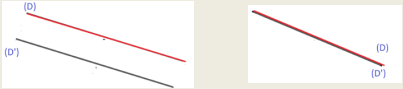
– The two lines (D) and (D’) are parallel lines or superposable lines, so they have the same direction

Définition :

â–¶ A line in the plane determine a direction
â–¶ Two lines (D) and (D’) have the same direction if (D) and (D’) are parallel lines or superposable lines.
â–¶ If Two lines (D) and (D’) are secants lines then the two lines (D) and (D’) haven’t the same direction.

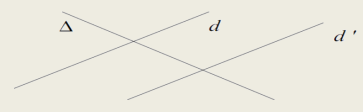
Exemple :

– We consider the following figures :
– The two lines (d) and (d’) are parallel, so they have the same direction.
– The two lines ( $\Delta$ ) and ( d ) are secant lines, so they haven’t the same direction.
Remark :

â–ş Two distinct(different) points $A$ and $B$ determine one direction which is the line (AB) and all the parallel lines to the line $(A B)$.

2. The sense :

Définition :

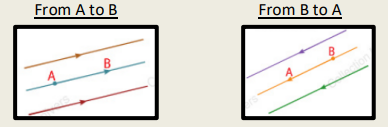
– We consider the line (AB) or (d)
– We can determine two possible senses in the line (AB)
â–¶ Sense 1 : From A to B.
â–¶ Sense 2 : From B to A.

Remark :

â–ş Attention : the word direction in our daily life is confused with the sense, In MATH we choose the direction (the line) first then we choose the sense.
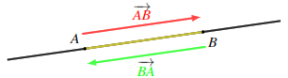
– Two distinct(different) points A and B determine in the direction of the line (AB) two opposites senses indicated with arrows,
Définition :

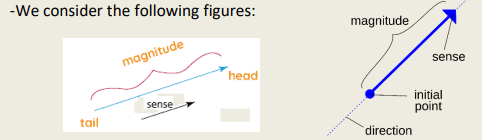
A vector is a geometrical entity ; it’s a combination of three things :
– A direction (a line) in space,
– A sense from the tail to the head.
– A positive number called its magnitude,
– Typically, a vector is illustrated as a directed straight line.

The vector in this example $\overrightarrow{A B}$ with :
âś“ $\checkmark$ The direction of the vector $\overrightarrow{A B}$ which is the line ( AB )
âś“ $\checkmark$ The sense of the arrow, from the point A to the point B ,
âś“ $\checkmark$ The magnitude of $\overrightarrow{A B}$ given by the length of the distance AB .
âś“ $\checkmark$ The origine (Tail or origine point) which is the point A
âś“ $\checkmark$ The head (the extremity or the arrowhead) which is the point B

Exemple :
Remark :

âť– A vector can be represented by a line with an arrow pointing towards its sense and its length represents the magnitude of the vector.
âť– Vectors are represented by arrows; they have initial points and terminal points.
âť– Every two distinct points A and B determine two vectors : $\overrightarrow{A B}$ and $\overrightarrow{B A}$
$\begin{aligned} & \text { The vector } \overrightarrow{A B} \text { is } \\ & \text { characterized by: }\end{aligned}\left\{\begin{array}{l}\text { The direction: }(\mathrm{AB}) \\ \text { The sense: } \mathrm{A} \Rightarrow \mathrm{B} \\ \text { The magnitude : the distance } \mathrm{AB}\end{array}\right.$

1. The null/zero vector :

Définition :

â–ş A vector with no direction and no sense and magnitude equal to 0 is known as null or zero vector
â–ş Every point in the plane determines a vector called null vector
â–ş We write : $\overrightarrow{A A}=\overrightarrow{0}$
â–ş If $\overrightarrow{A B}=\overrightarrow{0} \quad$ Then $\quad \mathbf{A}=\mathbf{B}$ (The two points $\mathbf{A}$ and $\mathbf{B}$ are the same point)
â–ş If $\overrightarrow{A B}=\overrightarrow{0} \quad$ Then $\quad \overrightarrow{A B}=\overrightarrow{A A}=\overrightarrow{B B}=\overrightarrow{0}$

2. The opposite of a vector :

Définition :

â–ş A and B are two distinct points of the plane.
â–ş We have : $\overrightarrow{A B}+\overrightarrow{B A}=\overrightarrow{0}$
â–ş The vector $\overrightarrow{B A}$ is the opposite vector of the vector $\overrightarrow{A B}$
And we write: $\overrightarrow{B A}=-\overrightarrow{A B}$

Exemple :

We consider the following figure :
Définition :

â–ş Two vectors are equal if they have:
The same direction
The same sense
The same magnitude
â–ş $\overrightarrow{A B} \overrightarrow{C D}$ if:
– $\overrightarrow{A B}$ and $\overrightarrow{C D}$ have the same direction; ( $\mathbf{A B}$ )//(DC)
– $\overrightarrow{A B}$ and $\overrightarrow{C D}$ have the same sense; $[\mathrm{AB})$ and $[\mathrm{DC})$ have the same sense
– $\overrightarrow{A B}$ and $\overrightarrow{C D}$ have the same magnitude; $\mathbf{A B}=\mathbf{D C}$

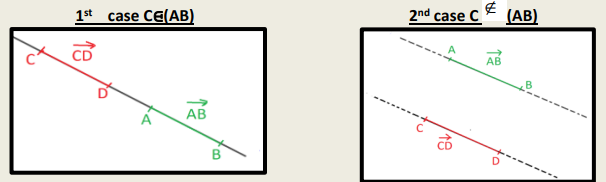
Exemple :

– We consider the following figures :
 

Remark :

âť– The equality $\overrightarrow{A B} \overrightarrow{C D}$ regroup three conditions, the three conditions (the direction, the sense, the magnitude) should be verified to say that: $\overrightarrow{A B} \overrightarrow{C D}$

Propriety :

$A, B, C$ and $D$ are distinct points such as $C^{\notin}(A B)$
If $\overrightarrow{A B}=\overrightarrow{D C}$
Then : $\quad-\mathrm{ABCD}$ is a parallelogram
            $-[\mathrm{AC}]$ and $[\mathrm{BD}]$ have the same midpoint

Exemple :

– We consider the following figure :
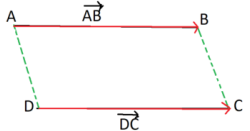
– We have $\overrightarrow{A B}=\overrightarrow{D C}$
– Then $(\mathrm{AB}) / /(\mathrm{DC})$ and $\mathrm{AB}=\mathrm{DC}$
– So : ABCD is a parallelogram
The diagonals $[A C]$ and $[B D]$ have the same midpoint

Propriety 2 :

$A, B, C$ and $D$ are distinct points such as $C^{\notin}(A B)$
If ${A B C D}$ is a parallelogram  Then $\quad \overrightarrow{A B}=\overline{D C}$

Exemple :

– We consider the following figure :
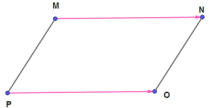
– We have MNOP is a parallelogram
– Then $\overrightarrow{M N}=\overrightarrow{P O}$ and $\overrightarrow{M P}=\overrightarrow{N O}$

Propriety 3 :

$\overrightarrow{A B}$ and $\overrightarrow{A D}$ are non null vectors
If $\overrightarrow{A B} \overrightarrow{A D}$ Then $B=D$

Propriety 4 :

$\mathrm{A}, \mathrm{B}, \mathrm{C}$ are distinct points in the plane
If $\overrightarrow{A B}=\overrightarrow{B C}$ Then B is the midpoint of the segment $[\mathrm{AC}]$
If $\overrightarrow{B A}=\overrightarrow{C B}$ Then B is the midpoint of the segment $[\mathrm{AC}]$

1. The sum of vectors (Triangle method) :

Définition :

â–ş The vectors addition (Triangle method)
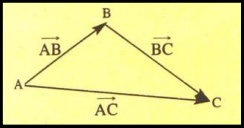
– To add two vectors $\overrightarrow{A B}$ and $\overrightarrow{B C}$ we follow the steps :
Step 1 : Draw the vector $\overrightarrow{A B}$
Step 2 : At the head (the arrowhead) of $\overrightarrow{A B}$, draw the vector $\overrightarrow{B C}$.
Step 3 : Join the beginning of $\overrightarrow{A B}$ to the head (the arrowhead) of $\overrightarrow{B C}$
â–ş This is vector $\overrightarrow{A B}+\overrightarrow{B C}=\overrightarrow{A C}$

Exemple :

– We consider the following figure :
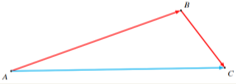
– $\overrightarrow{A B}+\overrightarrow{B C}=\overrightarrow{A C}$

The sum of two vectors is a vector

2. The sum of vectors (Parallelogram method) :

Définition :

â–ş The vectors addition (Parallelogram method)
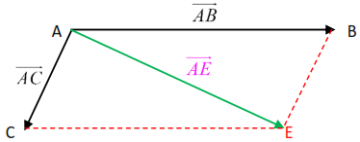
– The sum of the two vectors $\overrightarrow{A B}$ and $\overrightarrow{A C}$ is the vectors $\overrightarrow{A E}$ such as :
â–ş ABEC is a parallelogram

Exemple :

– We consider the following figure :
– $\overrightarrow{A B}+\overrightarrow{A C}=\overrightarrow{A E}$

The sum of the two vectors is the diagonal of
the parallelogram

Proprieties :

â–ş $\mathrm{A}, \mathrm{B}, \mathrm{C}, \mathrm{D}, \mathrm{E}$ and F are distinct points in the plane
â–ş $\overrightarrow{A B}, \overrightarrow{C D}$ and $\overrightarrow{E F}$ are non null vectors
â–ş The sum of vectors is commutative :
$$
\overrightarrow{A B}+\overrightarrow{C D}=\overrightarrow{C D}+\overrightarrow{A B}
$$
â–ş The sum of vectors is summative :
$$
\overrightarrow{(\overrightarrow{A B}+\overrightarrow{C D})}+\overrightarrow{E F}=\overrightarrow{A B}+(\overrightarrow{C D}+\overrightarrow{E F})
$$
â–ş The sum of the zero vector :
$$
\overrightarrow{A B}+\overrightarrow{0}=\overrightarrow{0}+\overrightarrow{A B}=\overrightarrow{A B}
$$

3. CHASLES theorem :

Rule :

â–ş For three distinct points $\mathrm{A} ; \mathrm{B}$ and C
– We have :
$$
\overrightarrow{A B}+\overrightarrow{B C}=\overrightarrow{A C}
$$

Exemple :

– We consider the following figure :
– $\overrightarrow{A B}+\overrightarrow{B C}=\overrightarrow{A C}$

Exemple 2 :

Without drawing simplify the following expressions :

$\begin{aligned} \overrightarrow{E F}+\overrightarrow{G E}+\overrightarrow{F G} & =\overrightarrow{E F}+\overrightarrow{F G}+\overrightarrow{G E} \\ & =\overrightarrow{E G}+\overrightarrow{G E} \\ & =\overrightarrow{E E} \\ & =\vec{O}\end{aligned}$

$\begin{aligned} \overrightarrow{A B}-\overrightarrow{B D}+\overrightarrow{C A}-\overrightarrow{C B} & =\overrightarrow{A B}+\overrightarrow{D B}+\overrightarrow{C A}+\overrightarrow{B C} \\ & =\overrightarrow{A B}+\overrightarrow{B C}+\overrightarrow{C A}+\overrightarrow{D B} \\ & =\overrightarrow{A C}+\overrightarrow{C A}+\overrightarrow{D B} \\ & =\overrightarrow{A A}+\overrightarrow{D B} \\ & =\vec{O}+\overrightarrow{D B} \\ & =\overrightarrow{D B}\end{aligned}$

4. The sum of many vectors :

Rule :

â–ş For three distinct points $\mathrm{A} ; \mathrm{B}$ and C
– We have :
$$
\overrightarrow{A B}+\overrightarrow{B C}=\overrightarrow{A C}
$$

5. The Midpoint of a segments :

Rule :

â–ş$\overrightarrow{A B}$ is a non null vector and M is midpoint of $[\mathrm{AB}]$;
– We have: $\overrightarrow{A M}+\overrightarrow{B M}=\overrightarrow{0}$
$$
\begin{aligned}
& \overrightarrow{M A}+\overrightarrow{M B}=\overrightarrow{0} \\
& \overrightarrow{A M}=\frac{1}{2} \overrightarrow{A B} \\
& \overrightarrow{A B}=\mathbf{2} \times \overrightarrow{A M}=\mathbf{2} \times \overrightarrow{M B}
\end{aligned}
$$

Définition :

â–ş $\overrightarrow{A B}$ and $\overrightarrow{C D}$ are non null vectors
â–ş To subtract two vectors we add the opposite vector of the second vector
$\begin{aligned} \overrightarrow{A B}-\overrightarrow{C D}= & \overrightarrow{A B}+(-\overrightarrow{C D}) \\ & =\overrightarrow{A B}+\overrightarrow{D C}\end{aligned}$
â–ş $\overrightarrow{A B}-\overrightarrow{C D}$ is called the difference between the two vectors $\overrightarrow{A B}$ and $\overrightarrow{C D}$

Exemple :

– We have : A, B and C are three distinct points.
– Let’s calculate $\overrightarrow{A B}-\overrightarrow{A C}$
$\begin{aligned} \overrightarrow{A B}-\overrightarrow{A C} & =\overrightarrow{A B}+(-\overrightarrow{A C}) & & \rightarrow \text { Using the definition of subtract } \\ & =\overrightarrow{A B}+\overrightarrow{C A} & & \rightarrow \text { Using the definition opposite vectors } \\ & =\overrightarrow{C A}+\overrightarrow{A B} & & \rightarrow \text { We can change the order of vectors } \\ & =\overrightarrow{C B} & & \rightarrow \text { Using CHASLES theorem }\end{aligned}$

Rule :

â–ş $\overrightarrow{A B}$ is a non-null vector and $\mathbf{n}$ is an integer;
– We have : $\overrightarrow{A B}+\overrightarrow{A B}+\ldots \ldots \ldots \ldots+\overrightarrow{A B}=\mathbf{n} \times \overrightarrow{A B}$

Exemple :

– We have : $\quad \overrightarrow{A B}+\overrightarrow{A B}+\overrightarrow{A B}=3 \times \overrightarrow{A B} \quad$ and $\quad(-\overrightarrow{M N})+(-\overrightarrow{M N})=(-2) \times \overrightarrow{M N}$

Remark :

âť– $\overrightarrow{A B}$ is a non null vector and $\mathbf{n}$ is an integer; $\mathbf{n} \times \overrightarrow{A B}=(-\mathbf{n}) \times \overrightarrow{B A}$

Définition :

â–ş When we drag(move) a figure (1) from point E to point K in a straight line without turn it, to get the figure (2)
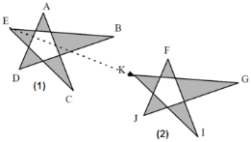
– We say that : the figure (2) is the image of the figure (1) with translation that transforms the point $E$ to the point K or with respect to the Vector $\overrightarrow{E K}$

Définition :

â–ş A, B and M are distinct points of the plane :
â–ş$\overrightarrow{A B}$ is a non null vector
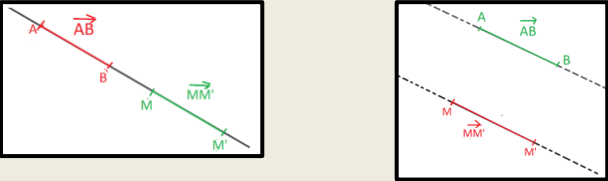
â–ş We say that: the point M’ is the image of point M with translation that transforms the point $\mathbf{A}$ to the point $\mathbf{B}$ (or with respect to the Vector $\overrightarrow{A B}$ ) if $\quad \overrightarrow{A B}=\overrightarrow{M M^{\prime}}$
â–ş We note : $t_{\overline{A B}}(\mathbf{M})=\mathbf{M}^{\prime}$
â–ş It means that :
– The two lines (AB) and (MM’) have the same direction
– The sense from $M$ to $M$ ‘ is the same sense from $A$ to $B$
– The two distances AB and $\mathrm{MM}^{\prime}$ are equal

Exemple :

$\overrightarrow{A B}$ is a non null vector. M and $\mathrm{M}^{\prime}$ are points such $\overrightarrow{M M^{\prime}}=\overrightarrow{A B}$
– the point $\mathbf{M}^{\prime}$ is the image of point $\mathbf{M}$ with translation that transforms the point $\mathbf{A}$ to the point B (or with respect to the Vector $\overrightarrow{A B}$ )
Remark :

âť– $\overrightarrow{A B}$ is a non-null vector. M and $\mathrm{M}^{\prime}$ are points such $\overrightarrow{M M^{\prime}}=\overrightarrow{A B}$
âť– the point $\mathbf{M}^{\prime}$ is the image of point $\mathbf{M}$ with translation that transforms the point $\mathbf{A}$ to the point $B$ (or with respect to the Vector $\overrightarrow{A B}$ )
âť– Means that : $\mathbf{A B M} \mathbf{M}$ is a parallelogram