Equations
I- 1st degree equation with one variable
1. Définition of an equation :
Définition of an equation :
▶ An EQUATION is an equality of two expressions (the MEMBERS of the equation) in which letters
appear to represent unknown numbers.
▶ These letters are called the VARIABLES of the equation.
▶ If we replace these variables with any random value, the equality will always be false.
▶ In cases where the equality is verified, the value is said to be a SOLUTION of the equation.
Exemple :
➤ t is a rational number,
➤ $(-3) \mathbf{t}+\frac{1}{4}=12+\frac{5}{11} \mathbf{t}$ is an equation; $\mathbf{t}$ is the unknown,
➤ $\left((-3) t+\frac{1}{4}\right)$ and $\left(12+\frac{5}{11} t\right)$ are the members of this equation
➤ If we replace $t$ by 0 and calculate each member of the equation separately:
$(-3) \times 0+\frac{1}{4}=\frac{1}{4} \quad 12+\frac{5}{11} \times 0=12$
– Since $\frac{1}{4} \neq 12$ So $\mathbf{0}$ is not a solution to the equation.
➤ If we replace $\mathbf{t}$ by $\left(\frac{-517}{152}\right.$ and calculate each member of the equation separately:
$\begin{aligned} & (-3) \times)+\frac{1}{4}=\frac{1551}{152}+\frac{38}{152}=\frac{1589}{152} \\ & \left.12+\frac{5}{11} \times\right)=12-\frac{2585}{1672}=\frac{20064}{1672}-\frac{2585}{1672}=\frac{17479}{1672}=\frac{1589}{152}\end{aligned}$
– Since $\frac{1589}{152}=\frac{1589}{152}$, both members are equal.
– So $\left(\frac{-517}{152}\right.$ is a solution to the equation.
2. The degree of an equation :
Définition :
▶ x is a rational number, $\mathrm{a} ; \mathrm{b} ; \mathrm{c}$ and d are known rational number.
▶ Any equation of the form $\mathbf{a x + b = 0}$ or $\mathbf{a x}=\mathbf{b}$ or $\mathbf{a x + b}=\mathbf{c x}+\mathbf{d}$ is a first-degree equation with a single unknown $x$
▶ The value of the number x that verifies this equation is the solution of this equation
Remark :
▸ $x$ and $y$ are two rational numbers; $2 x+\frac{1}{-4} y-1=0$ : is a first-degree equation with two variables x and y .
▸ x is rational number; $\mathrm{x}^2-\frac{1}{4}=0$ : is a second-degree equation with a single variable x .
▸ $\mathbf{x}$ is rational number; $\frac{x}{2}-\frac{1}{3}=\frac{2 x-3}{6}$ is a first-degree equation with one variable $\mathbf{x}$
II- Solving the 1st degree equation with one variable
Définition :
– Solving the first-degree equation with a single variable :
▶ It means finding the value of the variable that makes the equality true;
▶ And to solve this equation, we apply one of the following properties
Propriety :
– $a, b$ and $c$ are rational numbers with $c \neq 0$ :
We have: if $a=b$ Thena $\times c=b \times c$
$$
\text { if } a=b \text { Then } \frac{a}{c}=\frac{b}{c}
$$
Exemple :
$$
\begin{array}{llll}
\text { We have: } & -17=-17 & \text { We have : } & x+3=-7 \\
\text { So : } & -17+29=-17+29 & \text { So : } & x+3+(-3)=-7+(-3) \\
\text { Then : } & 12=12 & \text { Then : } & x=-10
\end{array}
$$
Propriety :
– $a, b$ and $c$ are rational numbers with $c \neq 0$ :
We have: if $a=b$ Thena $\times c=b \times c$
if $a=b$ Then $\frac{a}{c}=\frac{b}{c}$
Exemple :
$$
\begin{array}{ll}
\\
\text { We have : } 11=11 & \text { We have : } 5 \mathrm{x}=-15 \\
\text { So : } \quad 11 \times(-4)=11 \times(-4) & \text { So : } \quad 5 x \times \frac{1}{5}=-15 \times \frac{1}{5} \\
\text { Then : } \quad-44=-44 \quad & \text { Then : } \quad x=-3
\end{array}
$$
Exemple 2 :
– x is a rational number :
– Solve the following equation : $5(x-1)-x=4(x+2)$
– We have : $\quad 5(x-1)-x=4(x+2)$
– then : $5 x-5-x=4 x+8$
– so : $4 x=4 x+8$
– Means that : $\quad 0 x=8$
– Since there is no rational number verifying this equality.
– We say that the equation has no solution
Exemple 3 :
– x is a rational number :
– Solve the following equation : $\frac{x}{2}-\frac{1}{3}=\frac{2 x-3}{6}$
– We have : $\quad \frac{\frac{x}{2}-\frac{1}{3}}{3 x-2}=\frac{2 x-3}{6}$
then : $\quad \frac{3 x-3}{6}=\frac{2 x-3}{6}$
– so : $\quad 3 x-2 x=-3+2$
– Means that : $x=(-1)$
– Since $(-1)$ is a rational number then the solution to this equation is $(-1)$
Exemple 4 :
– x is a rational number:
– Solve the following equation : $3(x-1)+x=4 x-3$
– We have: $3(x-1)+x=4 x-3$
– So : $3 x-3+x=4 x-3$
– Means that : $4 x-3=4 x-3$
– then : $4 x-4 x=-3+3$
– Finally : $0 x=0$
– Since all the rational number can verify this equation,
– So all the rational numbers are solution to this equation
Propriety :
– x is an unknown rational number
– a and b are known rational numbers;
– A $1^{\text {st }}$ degree equation with one variable is an equality that after simplification we can write it in the form of $\mathbf{a x}+\mathbf{b}=\mathbf{0}$ where $a$ and $b$ are known numbers
– if $\mathbf{a} \neq \mathbf{0} \quad$ Then : the solution to the equation is $\frac{(-b)}{a}$
– if $\mathbf{a = 0}$ and $\mathbf{b} \neq \mathbf{0}$ Then : the equation has no solution
if $\mathbf{a = 0}$ and $\mathbf{b = 0}$ Then : All the rational numbers are solution to the equation,
III- Solving equations that can be written in the form of $(a x+b)(c x+d)=0$ and $(a x+b)^2=0$
Remark :
▸ To solve a second-degree equation with one variable, we use factorization and we write it as the form $(a x+b)(c x+d)=0$ or $(a x+b)^2=0$ then we use the following proprieties:
Propriety :
– a and b are rational numbers;
if $a \times b=0 \quad$ Then $a=0$ or $b=0$
Propriety :
– a is a rational number;
if $a^2=0 \quad$ Then $a=0$
Exemple :
– x is a rational number :
– Solve the following equation : $(3 x-6)(x+5)=0$
– We have : $\quad(3 x-6)(x+5)=0$
– So : $\quad 3 x-6=0 \quad$ or $\quad x+5=0$
– Means that: $\quad 3 x=6 \quad$ or $\quad x=-5$
– then : $\quad x=2 \quad$ or $\quad x=-5$
– Since 2 and $(-5)$ are rational numbers
– So 2 and $(-5)$ are solutions to this equation
Exemple 2 :
– x is a rational number :
– Solve the following equation : $x^2=16$
– We have : $x^2-4^2=0$
– Means that : $(x-4)(x+4)=0$
– then : $x-4=0 \quad$ or $\quad x+4=0$
– So : $x=4 \quad$ or $\quad x=-4$
– Since 4 and (-4) are rational numbers
– So 4 and (-4) are solutions to this equation
Exemple 3 :
– x is a rational number :
– Solve the following equation : $4 x^2-12 x+9=0$
– We have: $4 x^2-12 x+9=0$
– So : $(2 x)^2-2 \times 2 x \times 3+(3)^2=0$
– Means that : $(2 x-3)^2=0$
– then : $2 x-3=0$
– So : $2 x=3$
– Finally, $x=\frac{3}{2}$
– Since $\frac{3}{2}$ is a rational number
– So $\frac{3}{2}$ is solution to this equation
IV- Problem Solving
Remark :
▸ Many problems can be translated into algebraic equations. To solve problems using algebra, we follow these steps :
Step 1 : Decide the unknown quantity and allocate it a variable such as $x$.
Step 2 : Translate the problem into an equation
Step 3 : Solve the equation by isolating the variable.
Step 4 : Check that the solution satisfies the original problem and write the answer in sentence form, describing how the solution relates to the original problem.
Exemple :
– GHALI bought a calculator and a book. The price of the book is the double of the price of the calculator. Knowing that GHALI has paid 45dh in the total determine the price of each article.
Step 1: Decide the variable
– We represent the price of the calculator with the variable $x$
– So, the price of the book is represented by $2 \times x=2 x$
Step 2 : Translate the problem into an equation
– The equation that represent the problem is : $x+2 x=45$
So $3 x=45$
Step 3 : Solve the equation
– we have $3 x=45$
So, $x=45 / 3=15$
Step 4 : Check the solution
– we have the price of the calculator is 15 dh and the price of the book is 30 dh , and $15+30=45$
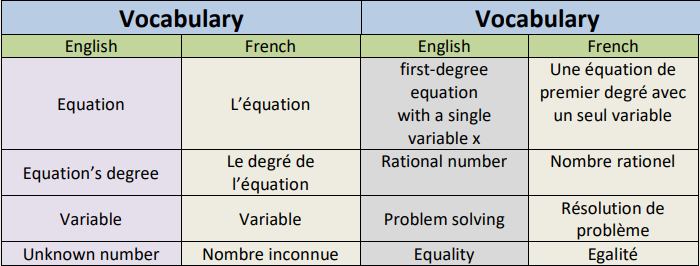
V- VOCABULARY