
leçon 3.3 La question qui fait penser

Leçon 3.3 — Module 3

La question qui fait penser

L’art de solliciter le raisonnement plutôt que la récitation.

🎯 Objectifs de la leçon

À la fin de cette leçon, vous serez capable de :

  • Formuler des questions déclenchant un raisonnement.
  • Utiliser le temps de réflexion pour augmenter la qualité des réponses.
  • Solliciter tous les élèves sans dépendre des volontaires habituels.
Idée clé

Une bonne question ne cherche pas une réponse rapide.

Elle oblige l’élève à traiter l’information.

Risque fréquent : Trop de questions “flash” produisent une participation visible, mais peu d’engagement cognitif réel.

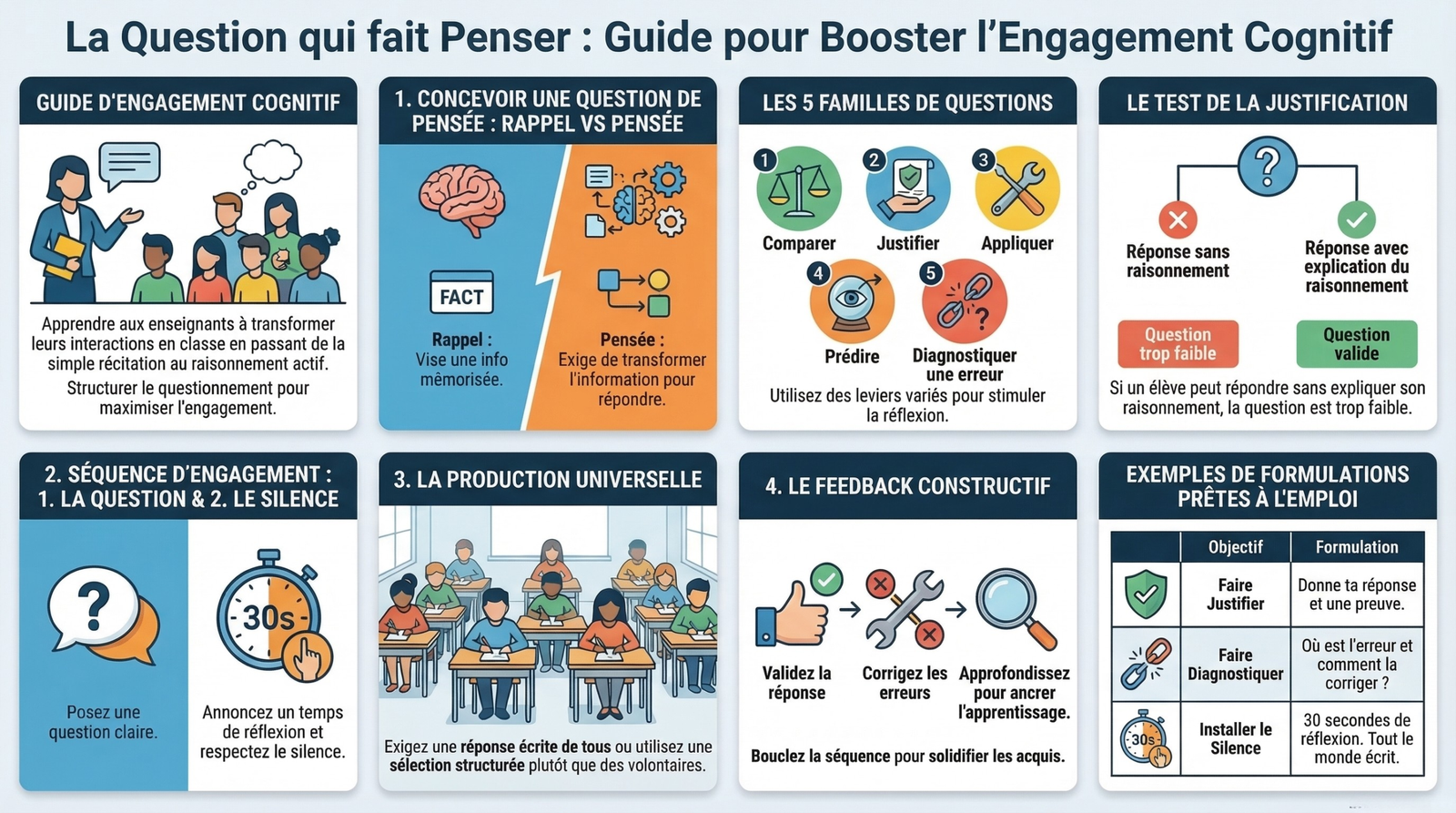
1) Rappel vs Pensée

Visualiser la différence entre une réponse rapide et un véritable traitement cognitif.

Question de rappel
  • Vise une info brute.
  • Réponse courte (Oui/Non).
  • Effet : Seuls les plus rapides répondent.
Question de pensée
  • Exige une transformation.
  • Réponse justifiée obligatoire.
  • Effet : Engage tout le groupe.

Question de rappel

  • Vise une info brute.
  • Réponse courte (Oui/Non).
  • Effet : Seuls les plus rapides répondent.

Question de pensée

  • Exige une transformation.
  • Réponse justifiée obligatoire.
  • Effet : Engage tout le groupe.

2) Les 5 familles de questions

Des cartes interactives pour ancrer les formulations qui activent la pensée.

Comparer : “Qu’est-ce qui change ici ? Pourquoi ?”

Justifier : “Comment le sais-tu ? Quelle est ta preuve ?”

Appliquer : “Comment utiliser cette règle dans ce nouveau cas ?”

Prédire : “Que va-t-il se passer si on change ce paramètre ?”

Diagnostiquer : “Où se trouve l’erreur dans ce raisonnement ?”

3) Le Temps de Réflexion (Wait Time)

Créer une micro-pause pédagogique qui laisse la pensée émerger.

Règle d’or : Annoncez un temps de réflexion en silence (30 secondes). Ne remplissez pas le vide par la parole.

0s 10s 20s 30s

Le silence permet aux élèves lents mais profonds d’entrer dans la réflexion.

4) Séquence en 4 étapes

Une progression visuelle simple à réutiliser dans un scénario de classe.

1

Question

Claire et orientée pensée.

2

Temps de réflexion

Annoncé et respecté.

3

Production

Écrite ou orale structurée.

4

Feedback

Validation et amélioration.

  1. Question : Claire et orientée pensée.
  2. Temps de réflexion : Annoncé et respecté.
  3. Production : Écrite ou orale structurée.
  4. Feedback : Validation et amélioration.

À retenir

La qualité des questions détermine la qualité de la pensée.

Lesson 3.3 — Module 3

The question that makes students think

Articulating reasoning over recitation.

🎯 Lesson Objectives

By the end of this lesson, you will be able to:

  • Formulate questions that trigger reasoning.
  • Use wait time to improve the quality of answers.
  • Involve all students without relying on habitual volunteers.

Key Idea

A strong question is not looking for a fast answer.

It forces students to process information.

Common risk: Rapid-fire questions create visible participation but low cognitive engagement.

1) Recall vs Thinking

Visualize the difference between a quick answer and genuine cognitive processing.

Recall question
  • Targets raw info.
  • Short answer (Yes/No).
  • Effect: Only the fastest respond.
Thinking question
  • Requires transformation.
  • Justification is required.
  • Effect: Engages the whole group.

Recall question

  • Targets raw info.
  • Short answer (Yes/No).
  • Effect: Only the fastest respond.

Thinking question

  • Requires transformation.
  • Justification is required.
  • Effect: Engages the whole group.

2) Five Question Families

Interactive cards to anchor the prompts that activate thinking.

Compare: “What is similar here? What changes? Why?”

Justify: “How do you know? What is your evidence?”

Apply: “How can we use this rule in this new case?”

Predict: “What will happen if we change this parameter?”

Diagnose: “Where is the error in this reasoning?”

3) Wait Time

Create a short instructional pause that lets thinking emerge.

Golden Rule: Announce a silent thinking time (30 seconds). Do not fill the void with speech.

0s 10s 20s 30s

Silence allows slow but deep thinkers to engage with the question.

4) 4-Step Routine

A simple visual progression that can be reused in a classroom routine.

1

Question

Clear and thinking-focused.

2

Wait Time

Announced and respected.

3

Production

Structured writing or speaking.

4

Feedback

Validation and improvement.

  1. Question: Clear and thinking-focused.
  2. Wait Time: Announced and respected.
  3. Production: Structured writing or speaking.
  4. Feedback: Validation and improvement.

Key Takeaway

The quality of questions determines the quality of thinking.

الدرس 3.3 — الوحدة 3

السؤال الذي يجعل التلاميذ يفكرون

فن استثارة التفكير بدلاً من الاسترجاع.

🎯 أهداف الدرس

في نهاية هذا الدرس ستكون قادراً على:

  • صياغة أسئلة تُحفز التفكير النقدي.
  • استخدام زمن الانتظار لرفع جودة الإجابات.
  • إشراك جميع التلاميذ دون الاعتماد على المتطوعين المعتادين.

الفكرة الأساسية

السؤال الجيد لا يبحث عن إجابة سريعة.

بل يجبر التلميذ على معالجة المعلومة.

خطر شائع: كثرة الأسئلة السريعة تعطي مشاركة ظاهرة لكنها انخراط ذهني ضعيف.

1) الاسترجاع مقابل التفكير

تصور الفرق بين الإجابة السريعة وبين المعالجة الذهنية الحقيقية.

سؤال استرجاع
  • يستهدف معلومة خام.
  • إجابة قصيرة (نعم/لا).
  • الأثر: يجيب الأسرع فقط.
سؤال تفكير
  • يتطلب معالجة ذهنية.
  • يستلزم تقديم مبرر.
  • الأثر: يشرك المجموعة كاملة.

سؤال استرجاع

  • يستهدف معلومة خام.
  • إجابة قصيرة (نعم/لا).
  • الأثر: يجيب الأسرع فقط.

سؤال تفكير

  • يتطلب معالجة ذهنية.
  • يستلزم تقديم مبرر.
  • الأثر: يشرك المجموعة كاملة.

2) العائلات الخمس للأسئلة

بطاقات تفاعلية لترسيخ الصيغ التي تنشط التفكير.

المقارنة: “ما أوجه الشبه هنا؟ ما الذي تغير؟ ولماذا؟”

التبرير: “كيف عرفت ذلك؟ ما هو دليلك؟”

التطبيق: “كيف يمكن تطبيق هذه القاعدة في هذه الحالة الجديدة؟”

التنبؤ: “ماذا سيحدث إذا قمنا بتغيير هذا العنصر؟”

التشخيص: “أين يكمن الخطأ في هذا الاستنتاج؟”

3) زمن التفكير

خلق وقفة تعليمية قصيرة تسمح بظهور التفكير.

القاعدة الذهبية: أعلن عن وقت للتفكير في صمت (30 ثانية). لا تملأ الفراغ بالكلام.

10ث 20ث 30ث

الصمت يسمح للتلاميذ ذوي التفكير المتأني بالدخول في العملية الذهنية.

4) روتين من 4 خطوات

تدرج بصري بسيط يمكن إعادة استخدامه داخل الممارسة الصفية.

1

السؤال

واضح وموجه للتفكير.

2

زمن الانتظار

معلن ومحترم.

3

الإنتاج

كتابة أو كلام منظم.

4

التغذية الراجعة

تثبيت وتحسين.

  1. السؤال: واضح وموجه للتفكير.
  2. زمن الانتظار: معلن ومحترم.
  3. الإنتاج: كتابة أو كلام منظم.
  4. التغذية الراجعة: تثبيت وتحسين.

الخلاصة

جودة الأسئلة تحدد جودة التفكير.