
leçon 3.1 Qu’est-ce que l’engagement réellement ?

Leçon 3.1 — Module 3

Qu’est-ce que l’engagement réellement ?

Distinguer la posture de l’activité mentale réelle.

🎯 Objectifs de la leçon

À la fin de cette leçon, vous serez capable de :

  • Distinguer l’engagement comportemental de l’engagement cognitif.
  • Identifier les fausses formes de participation (piège du silence).
  • Repérer les indicateurs concrets d’un engagement réel.
  • Analyser votre propre pratique via le test des 3 questions.
Idée clé

Le calme ne garantit pas l’apprentissage.

L’engagement réel se voit dans l’activité mentale.

Confusion fréquente : Le silence et la main levée sont des postures, pas nécessairement des preuves de réflexion.

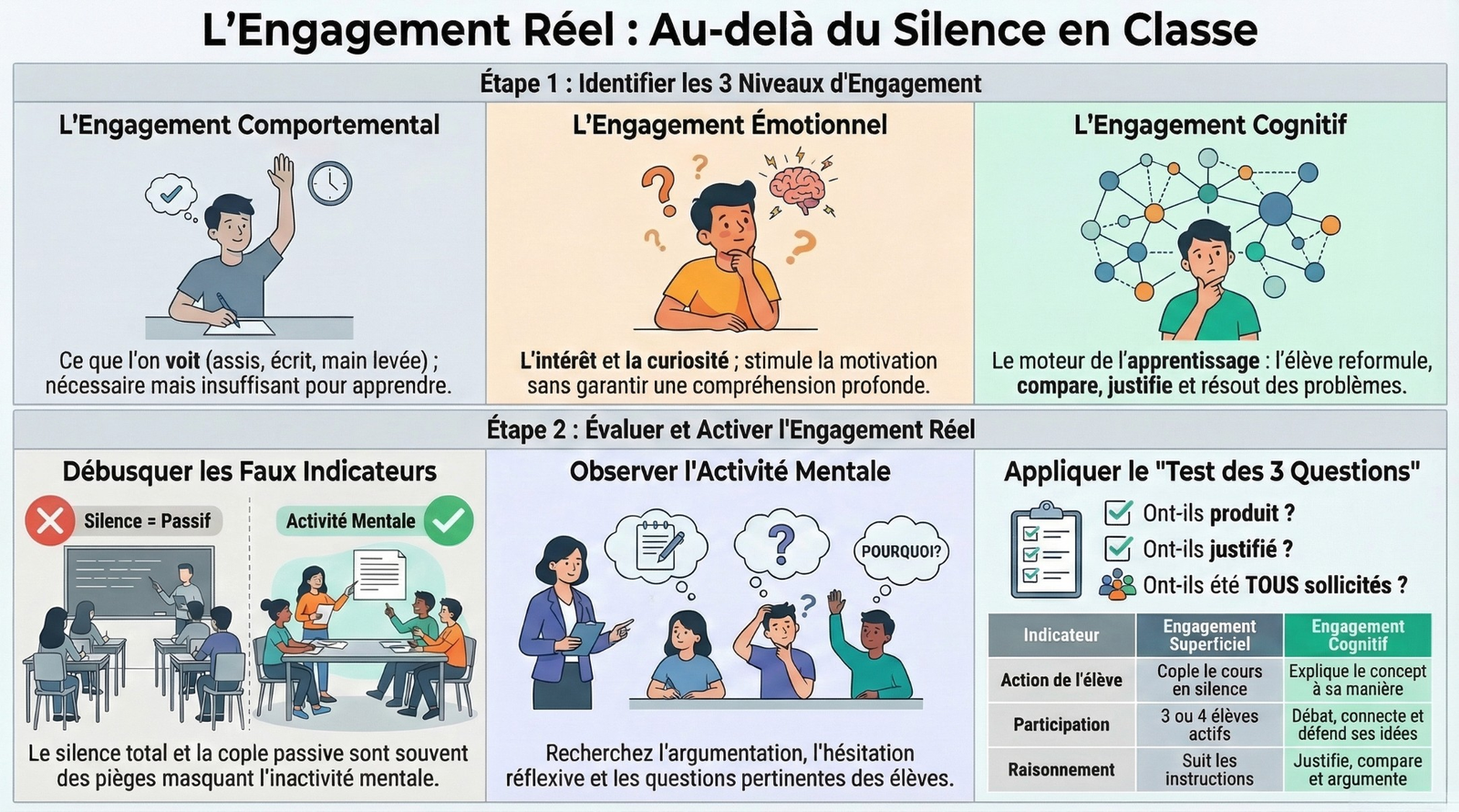
Les 3 niveaux d’engagement

Distinguer ce qui relève de la posture visible, de l’état émotionnel et du travail cognitif réel.

1) Engagement comportemental
  • Posture : assis, regarde le tableau, écrit.
  • Risque : peut copier sans comprendre.
2) Engagement émotionnel
  • Posture : curiosité, plaisir, motivation.
  • Risque : peut aimer le cours sans apprendre.
3) Engagement cognitif (Le Graal)

C’est ici que l’apprentissage se produit. L’élève :

  • Reformule avec ses propres mots.
  • Justifie ses réponses et résout des problèmes.
  • Pose des questions de compréhension profonde.

1) Engagement comportemental

  • Posture : assis, regarde le tableau, écrit.
  • Risque : peut copier sans comprendre.

2) Engagement émotionnel

  • Posture : curiosité, plaisir, motivation.
  • Risque : peut aimer le cours sans apprendre.

3) Engagement cognitif (Le Graal)

C’est ici que l’apprentissage se produit. L’élève :

  • Reformule avec ses propres mots.
  • Justifie ses réponses et résout des problèmes.
  • Pose des questions de compréhension profonde.

🛠 Outil : Le test des 3 questions

Un filtre simple pour vérifier si une activité produit de l’engagement réel ou seulement une participation de surface.

Pour chaque activité, demandez-vous :

1

Production

Les élèves ont-ils produit quelque chose (écrit, oral, schéma) ?

2

Justification

Ont-ils dû justifier ou comparer ?

3

Participation totale

Tous les élèves ont-ils été sollicités ?

  1. Les élèves ont-ils produit quelque chose (écrit, oral, schéma) ?
  2. Ont-ils dû justifier ou comparer ?
  3. Tous les élèves ont-ils été sollicités ?

Si la réponse est “Non” à deux questions ou plus, l’activité est probablement passive.

Lesson 3.1 — Module 3

What is engagement, really?

Distinguishing posture from actual mental activity.

🎯 Lesson Objectives

By the end of this lesson, you will be able to:

  • Distinguish behavioral engagement from cognitive engagement.
  • Identify false forms of participation (the silence trap).
  • Recognize concrete indicators of real engagement.
  • Analyze your own practice using the 3-question test.

Key Idea

Calm does not guarantee learning.

Real engagement is visible through mental activity.

Common Confusion: Silence and raised hands are postures, not necessarily proof of thinking.

The 3 Levels of Engagement

Separate visible posture, emotional state, and genuine cognitive work.

1) Behavioral Engagement
  • Posture: sitting, looking at the board, writing.
  • Risk: can copy without understanding.
2) Emotional Engagement
  • Posture: curiosity, enjoyment, motivation.
  • Risk: can like the class without deep learning.
3) Cognitive Engagement (The Goal)

This is where learning actually happens. The student:

  • Rephrases in their own words.
  • Justifies answers and solves problems.
  • Asks deep comprehension questions.

1) Behavioral Engagement

  • Posture: sitting, looking at the board, writing.
  • Risk: can copy without understanding.

2) Emotional Engagement

  • Posture: curiosity, enjoyment, motivation.
  • Risk: can like the class without deep learning.

3) Cognitive Engagement (The Goal)

This is where learning actually happens. The student:

  • Rephrases in their own words.
  • Justifies answers and solves problems.
  • Asks deep comprehension questions.

🛠 Tool: The 3-Question Test

A simple filter to check whether an activity generates real engagement or only surface participation.

For every activity, ask yourself:

1

Production

Did students produce something (writing, speaking, diagram)?

2

Justification

Did they have to justify or compare?

3

Total participation

Were all students involved?

  1. Did students produce something (writing, speaking, diagram)?
  2. Did they have to justify or compare?
  3. Were all students involved?

If the answer is “No” to two or more questions, the activity is likely passive.

الدرس 3.1 — الوحدة 3

ما هو الانخراط فعلاً؟

التمييز بين المظهر والنشاط الذهني الحقيقي.

🎯 أهداف الدرس

في نهاية هذا الدرس ستكون قادراً على:

  • التمييز بين الانخراط السلوكي والانخراط الذهني.
  • كشف المشاركة الشكلية (فخ الصمت).
  • التعرف على مؤشرات الانخراط الحقيقي.
  • تحليل ممارستك الصفية عبر اختبار الأسئلة الثلاثة.

الفكرة الأساسية

الهدوء لا يضمن التعلم.

الانخراط الحقيقي يظهر في النشاط الذهني.

خلط شائع: الصمت ورفع اليد مجرد مظاهر، وليست بالضرورة دليلاً على التفكير.

ثلاثة مستويات للانخراط

التمييز بين المظهر الخارجي، والحالة الوجدانية، والعمل الذهني الحقيقي.

1) الانخراط السلوكي
  • المظهر: جلوس، نظر للسبورة، كتابة.
  • الخطر: يمكن للتلميذ أن ينقل دون فهم.
2) الانخراط العاطفي
  • المظهر: فضول، استمتاع، دافعية.
  • الخطر: قد يحب التلميذ الحصة دون تعلم عميق.
3) الانخراط الذهني (الهدف الأسمى)

هنا يحدث التعلم الحقيقي. التلميذ:

  • يعيد الصياغة بكلماته الخاصة.
  • يبرر إجاباته ويحل المشكلات.
  • يطرح أسئلة فهم عميقة.

1) الانخراط السلوكي

  • المظهر: جلوس، نظر للسبورة، كتابة.
  • الخطر: يمكن للتلميذ أن ينقل دون فهم.

2) الانخراط العاطفي

  • المظهر: فضول، استمتاع، دافعية.
  • الخطر: قد يحب التلميذ الحصة دون تعلم عميق.

3) الانخراط الذهني (الهدف الأسمى)

هنا يحدث التعلم الحقيقي. التلميذ:

  • يعيد الصياغة بكلماته الخاصة.
  • يبرر إجاباته ويحل المشكلات.
  • يطرح أسئلة فهم عميقة.

🛠 أداة: اختبار الأسئلة الثلاثة

مرشح بسيط يساعد على التحقق مما إذا كان النشاط يولد انخراطاً حقيقياً أو مجرد مشاركة سطحية.

لكل نشاط، اسأل نفسك:

1

الإنتاج

هل أنتج التلاميذ شيئاً (كتابة، عرض شفهي، رسم)؟

2

التبرير

هل اضطروا للتبرير أو المقارنة؟

3

إشراك الجميع

هل تم إشراك جميع التلاميذ؟

  1. هل أنتج التلاميذ شيئاً (كتابة، عرض شفهي، رسم)؟
  2. هل اضطروا للتبرير أو المقارنة؟
  3. هل تم إشراك جميع التلاميذ؟

إذا كانت الإجابة “لا” على سؤالين أو أكثر، فالنشاط غالباً سلبي.